Interviews
Richard Garfield, Creator of Magic: The Gathering Talks Half Truth: Second Guess – Interview Series

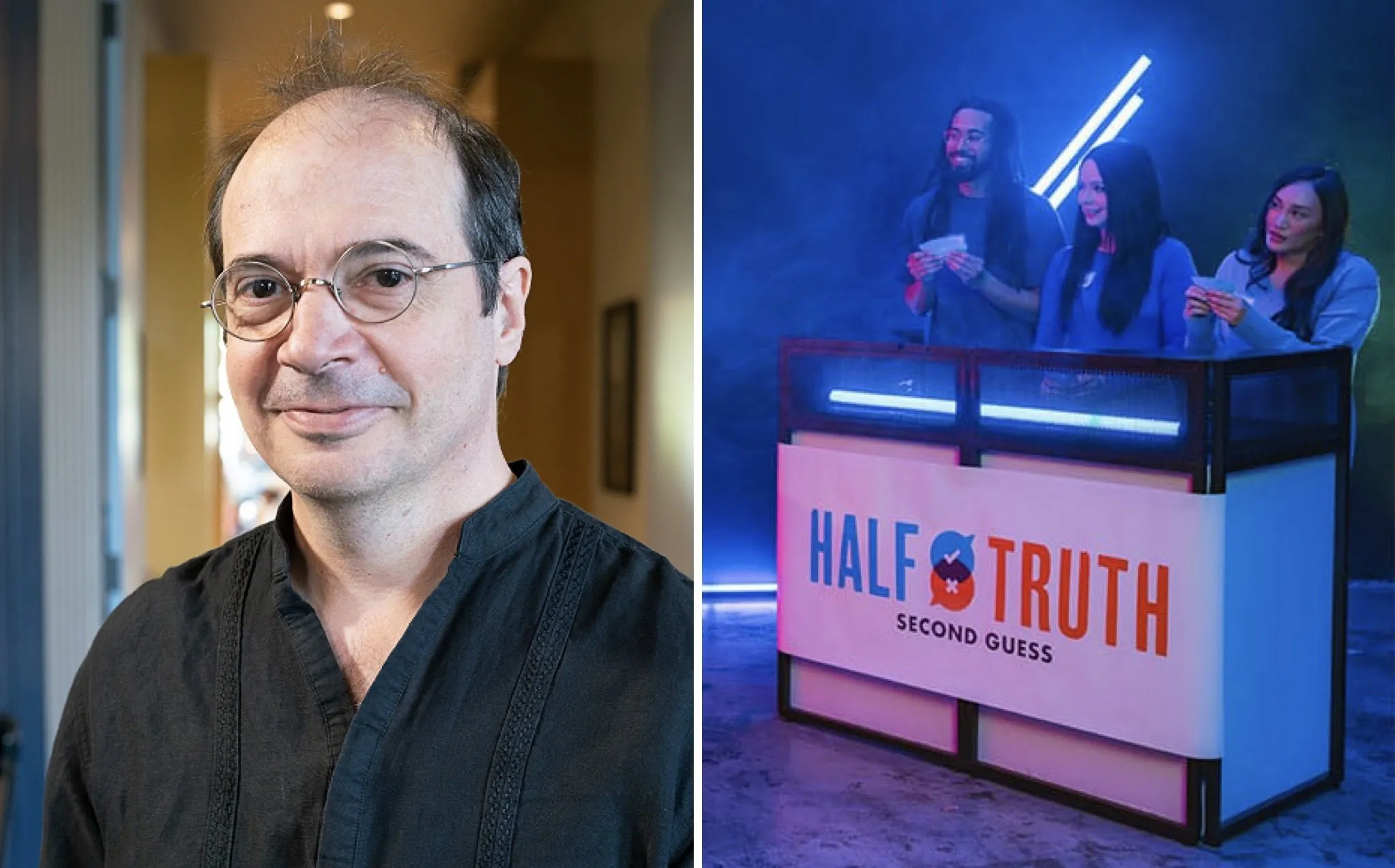
Richard Garfield, the creative wizard of Magic: The Gathering—the 1993 trading card game (TCG) that quite literally spearheaded the concept, is working to channel his fundamental ideas and passion for trivia into a new chapter for the beloved Half Truth series. Aptly titled Half Truth: Second Guess, the latest entry will reportedly include a vast array of fresh questions, game modes, and “components that allow for more players.”
Excited to learn more about the upcoming game and its surge in popularity over on Kickstarter, I decided to reach out to Richard, who kindly filled me in on all of the details.
Thanks for taking the time to sit down and speak with us — we really appreciate it! Before we touch base on the latest developments in the world of trivia, please could you introduce yourself to our readers? Who are you, and what brought you to this corner of the gaming industry?
Richard: I am Richard Garfield, best known for the creation of Magic — the first TCG. Since Magic was created I have been working in game design, and have created many other games, including King of Tokyo and Keyforge. I am dedicated to games as a whole, though, and am fascinated by all types of games, which includes party games. Another party game of my design was Hive Mind. Half Truth, in particular, was inspired by Ken Jennings wonderful book Braniac, which clearly explained his love of trivia, and why my preconceptions of that game form were not exactly accurate. In particular, he liked the broad nature of trivia— that everyone has troves of knowledge that differ and are fun to show off. I was driven to make a game that really brought that out and didn’t feel like only the biggest trivia nerds would have a chance.
Let’s talk about Half Truth. Could you please tell us more about how the game works? What are the rules, and how exactly does one conquer the deck, so to speak?
Richard: In Half Truth each question has six answers provided: three are true and three are not. Players are tasked with finding at least one of the true answers, but they can press their luck by trying for two or three answers. If any of their answers are wrong, however, they get nothing for the question. This format allows for a wide variety of questions, and no player ever has a worse than 50% chance of making progress; generally it is better though since even when clueless a player might be able to eliminate some answers or pick up some clues in other ways.
Half Truth: Second Guess, the long-awaited sequel to the universally popular prequel, is finally afoot over on Kickstarter. Tell us, what can we expect to see in this upcoming standalone chapter?
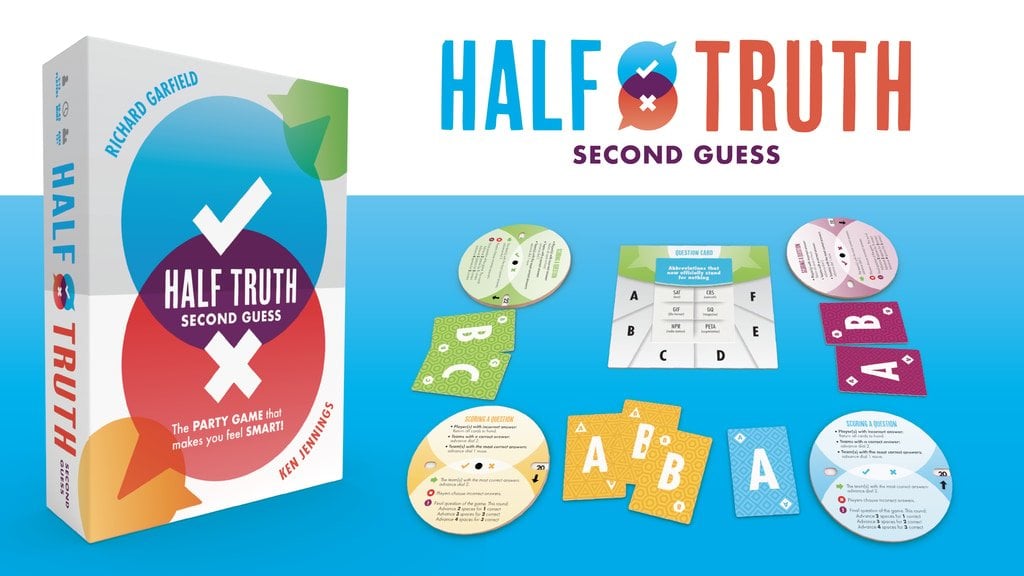
Richard: More questions, components that allow for more players, a faster mode of play, and team rules. The questions are the core of the game, and while I am very happy with how the original Half Truth turned out, we learned from it a lot of things that make for more consistently fun questions.
Credit: Nighthawk Games
Is there anything we should know before setting up our first game? Are there any tricks to help navigate the process?
Richard: Setting up is super easy, and really the whole concept is easy. Players will get six cards each, which correspond to the six possible answers. There is a die rolled, which determines the stakes of the next question, and the question is revealed. All players simultaneously, secretly, choose one, two, or 3 cards to play. The card is flipped so the answers can be seen and all players who answered with no incorrect cards get rewarded. Then, all players take their cards back. That is the entire play cycle.
Your undying love for trivia has helped to bring several different team-based games to life. Please could you tell us where this admiration for all things trivia came from?
Richard: The biggest inspiration was Ken’s book, Braniac, but, I am also a fan of puzzle hunts and competitions like pub trivia. My biggest epiphany came to me when I realized the high points of my trivia games were when the quiet players who didn’t answer that much knew something completely unexpected. I wanted a trivia game that allowed that as much as possible.
Looking ahead—to the aftermath of Half Truth: Second Guess’ global debut—do you think you’ll be interested in collaborating on any other projects? Care to share any details on what you’re thinking about creating?
Richard: Outside of Half Truth, I am always working on new games, both digital and analog. Within the Half Truth world, I hope that there is an interest in more questions, because they are fun to write and, I think, provide a lot of entertainment.

Credit: Nighthawk Games
Supporting the project on Kickstarter is one thing, but how else might we be able to contribute towards the fulfillment of Half Truth: Second Guess?
Richard: As with most games, there is nothing more valuable than play! The questions are the key and I am sure Nighthawk, the publisher, can provide a few. If players like the questions, they will like the game. Each question is a bit like a game unto itself.
To start you off, though, I will craft a question for you:
Which of these are breeds of cat?
A. Lycoi
B. Klefki
C. Sokoke
D. Korat
E. Cubone
F. Rotom
[Answers to the above question can be found at the bottom of the page]
Try to get one if you have no clue. See if you can eliminate any— or some just sound wrong or right. These questions are sometimes trivia, as in do you know it, but often it is driven by hunches or intuition in a way that other trivia games are often not.
Would you like to add anything for our readers?
Richard: If you like Wits and Wagers, you might find something new here. That game is also a trivia game that a broad audience can play… by design more number oriented. If you haven’t played Wits and Wagers, you should try it! It is a great game!
Thank you so much for your time, Richard!
[Answers]
Richard: The correct answers are ACD. Some readers may be able to cross off one or more since the negative answers are all Pokemon. In particular, if I were faced with this question, I wouldn’t know the cats, but I would recognize Cubone as a Pokemon, so I have improved my chances. Then, I might look for more Pokemon, and I think there is some chance I would recognize Rotom as being a Pokemon-like name since it is Motor backwards. I am not sure I would catch Klefki though, so I might find myself guessing on the remainder.
You can support Richard Garfield and Nighthawk Games’ latest project by visiting the Kickstarter campaign page here. For more information on the game, be sure to check in with the team over on their official X/Twitter handle here.

