Reviews
Far Cry Series Review (Xbox, PlayStation & PC)


Ubisoft has a soft spot for repetition; it bleeds through the crags and crevices of its trailing slogs, radio tower ascents, rebel camp takeovers, and its snail-like hero progression tropes that often require you to orbit the same chores hundreds of times over just to make an impact on the battlefield. Far Cry is no different, in that it leans on a lot of the same trappings as a Ubisoft IP. Take any chapter in the saga, for example. Frankly, it doesn’t matter which world you fall into, because you can almost guarantee that there’ll be a tyrant, a propaganda-fueled nation, and a boatload of camps for you to conquer and a seemingly infinite number of towers to climb. That is, in short, the Far Cry way, and it couldn’t care less if you love it or hate it.
It’s strange, because I almost feel excited to embark on a new journey with Far Cry. The truth is, however, that I usually forget about the mundane aspects of the previous chapter, and I willingly subject myself to the same things, oblivious to the fact that I am, weirdly, just doing the same thing over again. The worlds are different, true, yet the same problem remains: an evil governor yearns for power, and a rebel alliance vies for balance and social stability. It’s the same tale, but with a different lick of paint over the exterior. Africa, Asia, The Americas, and just about everywhere else that you could dare to throw two warring factions in and create a fifteen-hour scuffle. Suffice it to say, Far Cry has a pattern here, and it doesn’t take much for you to come to terms with the fact that, regardless of your space on the spectrum, you’re almost always working to accomplish the same goal.
The Definition of Predictability

Despite having an incredibly predictable formula and a lot of the same ingredients as your bog-standard open-world quelling expedition, Far Cry does manage to uphold its reputation as a solid first-person shooter saga with a lot of solid hooks and satisfying gameplay elements. In addition to its generously sized maps and mission varieties, each campaign also features its own collection of quotable characters (the definition of the word insanity immediately jolts to mind here), and a ton of side quests to keep you scraping through for a number of hours well beyond the post-game climax.
Speaking of the word insanity, it does seem awfully ironic that a series about completing the same generic tasks is also an advocate for the same definition. Of course, I wouldn’t say that all of the segments in the series are identical, though the similarities between the six episodes are evident beyond belief. And I think that’s one of the worst things about Far Cry: the fact that it chooses to stick to the same course and make a safe bet, despite having the breathing room to explore countless possibilities and narrative points. So, fair enough, it’s the centerpiece of the series, but it’s also a far cry from what the series could have had under the right guidance. In other words, Ubisoft played it safe, but frankly, it could have gone a lot further with the tools that it had at its disposal. A missed opportunity, really.
Familiarity Is Key

Arguably the best thing about any Far Cry game is its tyrants—the monolithic figureheads who spend each campaign belittling your efforts with brash dialogue, mid-game curveballs, and enough signature quotes to fill out a novella. Granted, the sixth installment went a little too far south, as it sidelined the antagonist rather than keep them as a present foe, similar to, say, the third, fourth, and fifth installments. The familiar plot and gameplay hooks were there, but overall it lacked a pulse to compete against its predecessors, with a huge open world but with no real sense of threat or poetic justice to fill it. Alas, one bad egg doesn’t necessarily make for a spoiled coop.
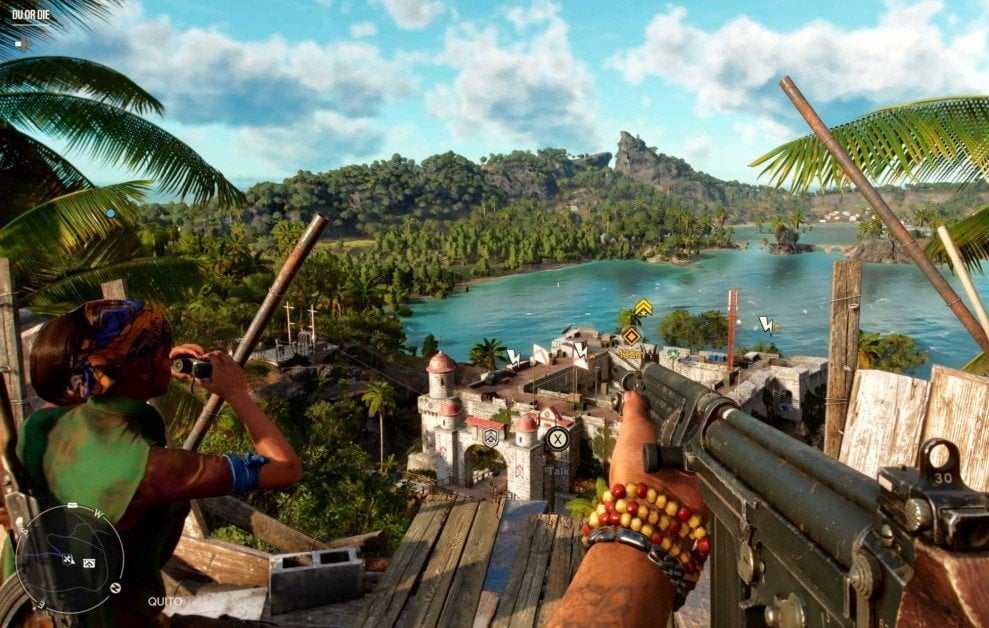
Suffice it to say, Far Cry fans are between two schools of thought, with one of them being in favor of the notion that the series ultimately found its peak at the third installment, and others finding that the series still has a lot of avenues left to explore. Between both opinions, I myself can’t help but wonder if Ubisoft has the power to incubate another chapter without falling into the same generic traps. Arguably, Ubisoft has the mantra of, if it ain’t broke, don’t fix it. That said, you do have to ask yourself the question: how much milk is left in the cash cow? Is the cow already dead?
Verdict

While Far Cry has been a kingmaker in the realm of first-person shooters for just over a decade, we have reached a point where Ubisoft has seemingly reduced the concept to a cliche, with fewer original ideas to keep the franchise alight and alluring features to keep you second guessing your familiar conquests. It isn’t that it’s a bad series; it’s that it hasn’t evolved all that much since its third installment. Regrettably, Far Cry hasn’t made much of an effort to alter its formula since its initial appearance at all. This isn’t to say that it lacks the steam to span future releases; it’s just that it needs a new lease to break out of its own shackles.
Although the worlds tend to expand and the missions gradually become meatier with each passing chapter, the bitter truth is that, despite there being more bang for your buck, Far Cry is a ridiculously repetitive IP. Don’t get me wrong, it’s still an entertaining FPS with a ton of fantastic features, but with no real variety or modern innovations, it sadly lacks the prowess of a timeless anthology. There’s hope for it, for sure, but without the wriggle room for maneuver, it’s hard to imagine that it will amount to much more than a trove of fairly generic clones with no defining qualities whatsoever.
With all of the above said, there is a reason as to why Ubisoft continues to mold additional branches for its Far Cry saga. When all’s said and done, it’s a series that is predictable yet safe, repetitive yet entertaining. And if there’s one thing that the folks over at Ubisoft are experts in, it’s creating annoyingly repetitive yet oddly satisfying sequels for their properties.
Far Cry Series Review (Xbox, PlayStation & PC)
Defining Insanity
Although the worlds tend to expand and the missions gradually become meatier with each passing chapter, the bitter truth is that, despite there being more bang for your buck, Far Cry is a ridiculously repetitive IP. Don’t get me wrong, it’s still an entertaining FPS with a ton of fantastic features, but with no real variety or modern innovations, it sadly lacks the prowess of a timeless anthology.