around the world
Mancala: Africa’s Ancient Game of Strategy and Chance

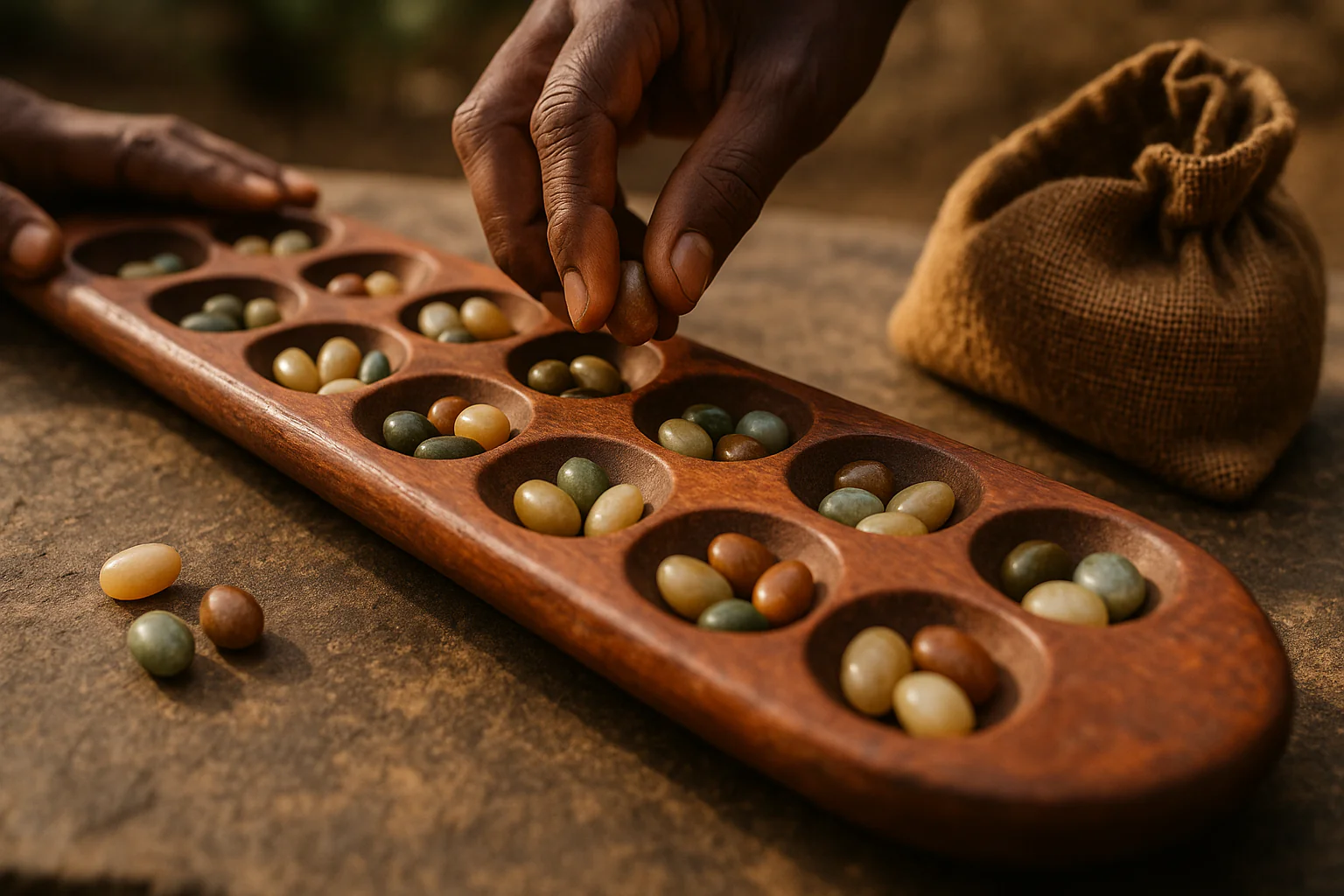
Mancala is an ancient African game that goes by many names across the continent and beyond. Across the African continent, and beyond, stretching to Southeast Asia, the far East, Europe and even among certain American communities, there are over 800 Mancala-like games. Mancala doesn’t use dice, cards, or other kinds of devices that produce random or luck-oriented elements in the game. It is more based around strategy, mathematics, and skill. Anticipating your opponent’s move and outwitting them is a crucial part of Mancala.
There are many variants of Mancala, and each game has its own rule variations or starting setups. But the principle of the game is almost the same, in that you are scooping and dropping tokens into holes. Nowadays, there are online versions of Mancala, gaming apps, and even AI-powered games against computers. Mancala continues to thrive today, and is very much a game of strategy and quick wits.
History and Spread of Mancala
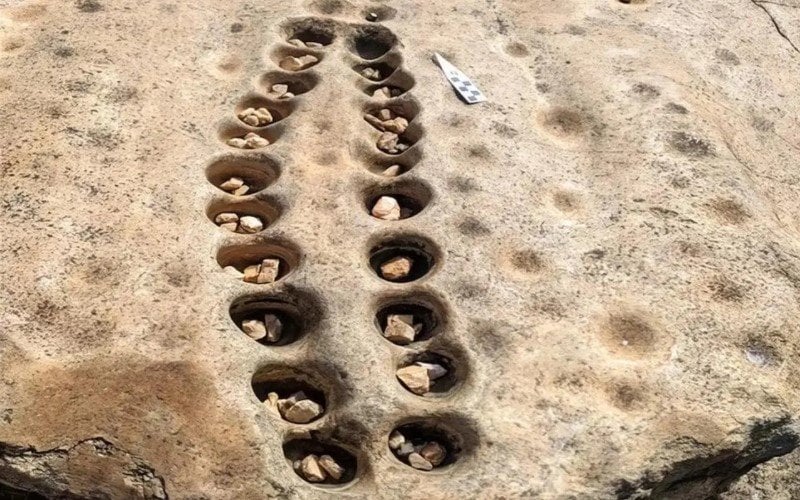
Mancala is among the oldest board games, and the earliest archaeological traces of the game data back to the third century AD. Historians trace Mancala-type games back to ancient Egypt, where people played them alongside Senet and other board games. Archaeologists face a unique challenge with Mancala because people can play it directly in the sand using small stones. Although it’s a board game, players only need to make small pits and use any kind of tokens to get started. Unlike the Royal Game of Ur or Hounds and Jackals, which required handcrafted boards and specially made pieces, Mancala needed only creativity and natural materials.
Some experts found boards and tools that could have been used for playing Mancala in a Neolithic residential area in Jordan. This would date Mancala type games as far back as the 6th millennium BC. It is quite tricky to determine how far this game dates back. But as it has spread nearly all across the world, with deep roots in various communities, it is safe to say that Mancala has had a tremendous cultural impact.
How to Play Mancala
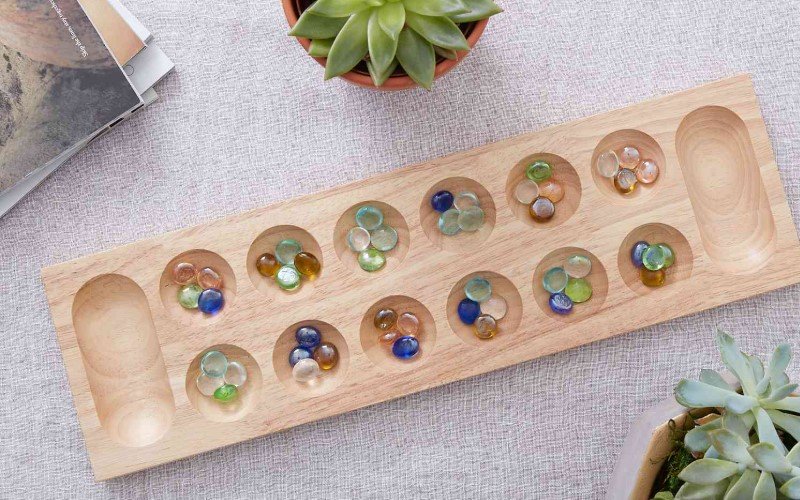
Mancala doesn’t require much equipment or tools. You can play it on handmade boards or using stones in a field. It is quite versatile that way. A playing field is needed, where there are pits, or little holes, in 2 rows. At the end of either row, there is a larger pit, or “store”, where you need to collect as many tokens as possible. The tokens can be small beads, stones, marbles, or seeds, depending on what you can source. You don’t need to distinguish them, they can be a set of 50 small grey stones.
The game is set up when the tokens are placed in the pits, and the stores are empty. A player can move the tokens from any of “their” pits, and their opponent moves the tokens from the other pits, in the second row. When moving tokens, you will have to pick up all the tokens from one pit, and then place them one by one into the following pits, into your store if you pass it, and then into your opponent’s pits. For example, if you have 5 tokens in one pit, you have to place 1 into the next 5 pits (including your storage if it falls on the way).
The goal is to get as many tokens into your store as possible. But be careful, as when the tokens go into your opponent’s pits, they can move them and try to get them into their store. The game ends when one player has a full set of empty pits, so they can’t make any more moves. The player with the most tokens wins.
Strategies to Enhance Your Mancala Games
The number of pits and tokens depends on the type of Mancala you are playing, and there are also variants where you can get bonus turns, more rows, and even those where you don’t place tokens one-by-one, but can place multiple tokens into one pit. Other games may not even use stores at all. Instead, they are all about capturing pits and tokens, the player with the most captured pits or tokens winning the game.
For new players who are playing a standard version of Mancala, there are some tips to help you get off to a better start. Try to start from the middle of your row, keeping tokens in more pits to ensure you still have turns later on in the game. Try to collect tokens in your store, and line up the tokens in pits so that you always end there, and don’t end up giving tokens to your opponent. Get more tokens on your side of the board, so that your opponent has fewer moves and options to pick from.
It is really quite a visually captivating game, and after a few tries you can build strategies on your own. Using visual pattern recognition, you will get a feel for how to overcome your opponent. But be careful, this is very much a game of wits as well. And opponents may try to throw you off by using alternating tactics and masking their master moves.
Main Variants and Their Distinctions
In the Horn of Africa, the game goes by the names Gabra and Selus, and uses very large boards. Sometimes, these can include 12 pits in each player’s row, opening up a myriad of strategies and possibilities. In East Africa, Tanzania and Kenya, the game is called Bao and Omweso, respectively. These games tend to use 4 rows, or 2 per player, and turns can be a lot longer and more complex.
Southern Africa uses a more standardized field, but games like Chisolo and Mafuvha in Malawi and Zambia give players the chance to move multiple seeds into one pit at the start. Kalah is a North American version of this game, that was brought to America during the Transatlantic Slave Trade. It is one of the most well known variants of Mancala in the Western World. But for the most part, Mancala didn’t really catch on in the West. It reached Indonesia, Singapore, Malaysia and the Philippines under the name Sungka. Or, to Kazakhstan and Kyrgyzstan under the name Toguz korgool or Toguz kumalak.
Mancala as an Educational and Cognitive Boosting Device
The game is pretty simple to learn, but the mathematical possibilities and strategy options are quite vast. This makes Mancala quite a useful tool to help boost cognitive functions in children. It is used as a device to help build early arithmetic skills and for children to recognize patterns. Psychologists also reckon variations of Mancala can also boost short term memory functions, and help activate critical thinking.
Though the main function of Mancala is not intended to be educational or as a cognitive enhancing device. It is a social game, that can be played among peers as a means of relaxation and bonding.
Gambling Elements of Mancala
In the base game, there are no gambling elements. And Mancala is not thought of as a game that can really serve for gamblers. It is too maths-based and doesn’t have any luck or chance element to it.
You wouldn’t really gamble on games of Tic-Tac-Toe or Link 4. Because these games do not have elements such as drawing a card or rolling a dice. It is those random and chance based elements that can open up gambling opportunities for a game.
Sure, you can place bets on Mancala among peers and friends. But it is not the kind of game that can be offered at an online casino. The casino cannot create an edge or price bets. The lack of randomness in Mancala doesn’t really lend to any kind of casino gaming or gambling.

Where to Play Mancala Today
Mancala is a game that remains highly popular across the African continent and in Asia. Handmade Mancala boards are a top choice souvenir for tourists to take home. But you can also play Mancala in coffeehouses, at markets and even in clubs or cultural centers. You never know when you may come across a Mancala tournament, and get a glimpse of top players going head to head in a tense and strategic showdown. Or, if you want to test it out from the comfort of your home, you can play Mancala online. There are multiplayer games you can play against other online players. Or, go head to head against the computer and set the difficulty level to meet your level.
But in truth, you don’t really need any special tools or equipment to play Mancala. A handful of tokens and designated pits or areas can also work. You can play Mancala as it was played in prehistory, and enjoy the thrilling masterpiece that has entertained since time immemorial.