Legends
The Origins of Las Vegas: From Desert Town to Gambling Mecca


Over 40 million tourists flock to the Las Vegas Strip every year, to what is arguably the world’s epicenter of gambling. The 24th most populous American city, ahead of much older cities such as Boston, Detroit, Memphis and Portland. And to think Las Vegas was founded just over 100 years ago, and most of the infrastructure today was created in the 90s, it is very much a new construct in America.
The first few things that come to mind when thinking about Vegas is the gigantic casino resorts, buzzing nightlife, celebrities from days of old, and the endless gambling opportunities across the Vegas Strip. But Las Vegas is not just a hotspot for gamblers and party-goers. Vegas is a shopper’s paradise, it also has a very diverse palette of architecture and history, and is a stone’s throw from some of America’s greatest wonders.
Origins of Las Vegas
Las Vegas, Spanish for “the meadows”, was originally just a stop along the Old Spanish Trail that connected Santa Fe in New Mexico and Los Angeles. The prehistoric Las Vegas Valley was a fertile area filled with vegetation and marshes, which evolved into arid landscapes and a desert. Yet there were still springs, wetlands and natural oases across the valley. In prehistoric times, going back over 10,000 years, the region was inhabited by native tribes. Archaeologists have found petroglyphs, pictographs and caves that suggest these nomadic tribes lived in the area until as early as 700 AD.
But the area around Las Vegas was mainly uninhabited apart from the occasional traders who stopped for water and shelter. In the 1850s, a group of Mormon missionaries stopped over at Las Vegas and built adobe forts. The Old Las Vegas Mormon Fort is still preserved today in the State Historic Park, but by 1857 it was no longer in use. The property was known as the best stop along the Old Spanish Trail until it was purchased in 1902 by the San Pedro, Los Angeles and Salt Lake Railroad.

Launching of the City of Las Vegas
The railroad was completed in 1905, linking Salt Lake City and southern California, and was overseen by US Senator William Andrews Clark. Clark built a second railroad branching off the line into the booming town of Bullfrog (now a ghost town). And with revenue and trade coming from the two directions, the area of Las Vegas slowly expanded. In 1905, the city was officially founded.
Soon thereafter, Clark County was established, and the city was incorporated into the county in 1911. Gambling was mostly banned in the western region of the US, and in 1910, Nevada became the last Western State to outlaw gambling. You couldn’t even flip a coin to gamble on the price of a drink. In 1922, a nationwide railroad strike left Vegas in dire financial circumstances.
Beginnings of Gambling Resorts
In 1930, President Herbert Hoover signed the appropriation bill to construct the Hoover Dam. Located just 30+ miles from Las Vegas, this new development injected a new lease of life into the city. Once again, Vegas started expanding and its population shot up from 5,000 to around 25,000. Locals came to find jobs in building and managing the dam, though it was still very much an area for working or commuting males. And this created a demand for large-scale entertainment.
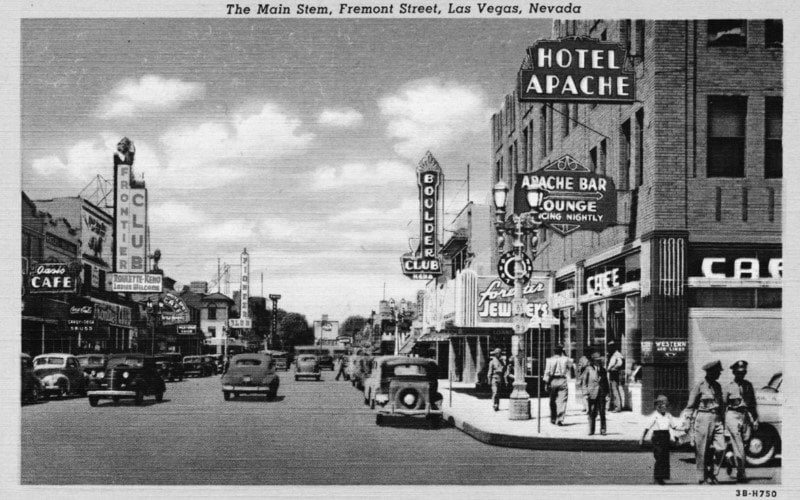
A year later, in 1931, Nevada made gambling legal at a state level. Las Vegas was the first city to legalize and issue gambling licenses to venues. The Northern Club, a hotel that was opened in 1920, obtained the first Nevada gaming license in Vegas. The hotel was located in Fremont Street, the main district for hotels and accommodations. Within a few years, other hotels obtained licenses and opened their own casinos. The only one still in operation today is Hotel Apache, which you can find on Las Vegas’ Fremont Street.
Mob Influence and Celebrity Culture
After the Second World War, Las Vegas was to take a turn. The casinos were mostly owned and run by local Las Vegas families. In 1946, gangster Bugsy Siegel built the Flamingo on some land he bought just outside Fremont Street. Alongside Moe Sedway and Gus Greenbaum, this land along US Route 91, was the first upscale venue of its kind. It was only a casino originally, but relaunched in 1947 with a hotel. This territory, which was relatively unused, would become the beginning of the Las Vegas Strip.
Siegel died in 1947, and in the next few years, Las Vegas expanded significantly. Organized crime was a big part of the influx of cash and funded the infrastructure of the post-War Vegas. By 1954, over 8 million people visited Vegas annually, pumping in $200 million into the casinos. Famous celebrities such as Frank Sinatra, Dean Martin, Bing Crosby and Sammy Davis Jr performed regularly at Vegas. It was really the place to go in America.
90s and Gambling Tourism Boom
The affiliation with the mob was slowly broken up in the years to come, and by the 1980s, the Mafia or Rat Pack came to a gradual end. In 1969, Kirk Kerkorian opened the International Hotel on the Strip. The first casino megaresort of its kind, it was intended to be the largest hotel in Vegas with over 1,500 rooms. This arguably started the mania for bigger and larger resorts in Vegas. Because his record-breaking hotel was surpassed in 1973 by the MGM Grand, also built by Kerkorian.
But the modern megaresorts in Vegas really all kicked off two decades later, in 1989. The Mirage was opened in 1989, by Steve Wynn. With over 3,000 rooms, the project cost a record-breaking $630 million to build, and became the first resort built on the Strip through the use of junk bonds in Wall Street. This drove up the gambling tourism drastically, and started a great race in the 1990s to build all-inclusive megaresorts along the Las Vegas Strip.
Next, came:
- The Excalibur (1990)
- Luxor (1993)
- MGM Grand (1993)
- Bellagio (1998)
- Mandalay Bay (1999)
- The Venetian (1999)
Modern Developments in Las Vegas
Megaresorts and luxurious venues were continuously erected along the Las Vegas Strip in the 2000s and the decades to come. And there are still planned projects along the Strip. But Las Vegas hasn’t just stuck to building resort after resort. In the 21st century, the city also brought in a handful of sports franchises and launched some expansion teams.
Las Vegas currently has two major professional sports franchises, with a third set to join in 2028. For some perspective, that is more than Nashville, Cincinnati, and Kansas City. The first was the Vegas Golden Knights of the NHL, an expansion team that was launched in 2017. Following that, the NFL’s Oakland Raiders moved to Las Vegas in 2020, relaunching as the Las Vegas Raiders. And the Oakland A’s in the MLB are also currently undergoing a move, which is set for 2028.
In 2023, the Caesars Palace Grand Prix was launched, and Vegas hosted a Formula One Grand Prix. Vegas is also the central headquarters of the UFC, in the UFC Apex. And, its big megaresorts have hosted professional boxing bouts since the 1980s. The likes of Mike Tyson, Evander Holyfield, Floyd Mayweather and Manny Pacquiao have all featured at Las Vegas Strip arenas.
Fremont Street vs The Strip
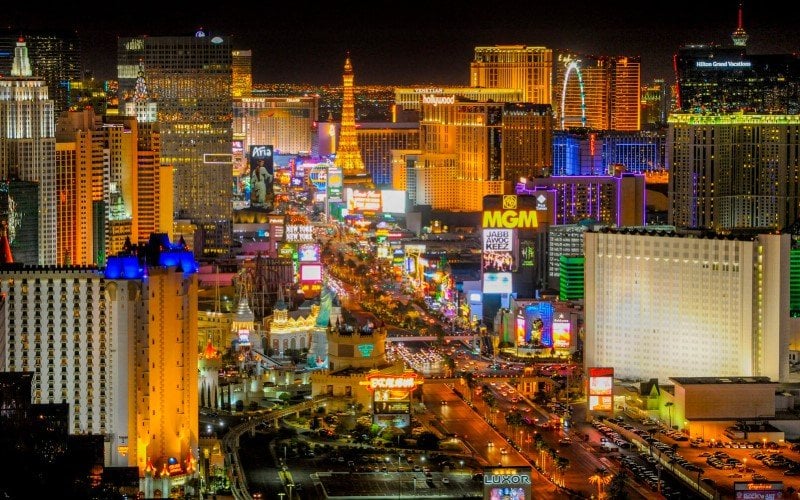
The Vegas Strip is the Vegas you see in the postcards and films. It is the glitzy area that is packed with megaresorts and gaming venues with thousands of machines. But while Fremont Street has arguably lost its place as “the” place to go in Vegas, it still exists today. You can find plenty of smaller casino hotels along Fremont Street, which offer a more intimate and historically authentic experience.
The Fremont Street Experience, a pedestrian mall, has street performers, free concerts and many small boutiques. It has an old-school charm, and offers a more budget friendly version of Vegas compared to The Strip. But for the biggest casinos in Las Vegas, you can hit the Strip.
These venues have thousands of slot machines, loads of gaming tables and even sportsbooks, exotic games areas, and the ever compelling high limit areas. If you have wads of cash to spend, you can even get a VIP experience at one of these resorts, with personal gaming hosts and concierges to cater the gambling experience to your liking. Plus, these casinos throw the biggest events in town, with A-list music acts, sports events, resident comedic acts, and much more.
Biggest Attractions Outside Gambling
Beyond gambling, there is no shortage of things to do when in Vegas. Don’t think of it as purely a gambling Mecca, as Vegas really caters to everyone’s tastes and needs. You can hit the Vegas Strip for an all-inclusive wellness getaway. Pools, spas, and world class treatment await anyone who wants a calm and peaceful weekend away.
Vegas also has a plethora of quality retailers and boutique shops. Plus, if you are staying at a Vegas Strip Caesars or MGM resort, you can also pick up discounts and loyalty rewards for your purchases. Another thing to consider is the great variety of diners and restaurants in Vegas. You can turn your Vegas trip into a foodies adventure, exploring celebrity chef diners to Michelin-starred restaurants.
For something completely different, you can explore the wildlife around Vegas. There are plenty of helicopter and truck tours to the nearby Grand Canyon, as well as the Hoover Dam. Don’t forget Zion National Park, Death Valley, and Red Rock Canyon, where you may even catch a glimpse of Petroglyphs that are over 10,000 years old. Within the city, there are plenty of museums and humble venues that detail the history of Vegas, a must for history lovers.
Las Vegas vs Other Casino Haven Cities
Las Vegas has a unique blend of entertainment and extravagance to such an extent that it doesn’t have many competitors. Macau has recently emerged as a rivaling destination to Las Vegas, with loads of huge casino resorts and shopping outlets. Then, there are the likes of Atlantic City in America, or Monte Carlo in Monaco. These also have big and historic casinos, but not as many as Vegas. Las Vegas is not a destination reserved for high stakes gamblers, as even casual gamers, poker pros and thrill seekers can all get their kicks at any one of the Vegas casinos.
The funny thing is that while Las Vegas is most famous for its gambling venues, there is so much more you can do when you visit. You can travel to Vegas 10 times and never touch a slot machine. Yet still have an adventure-packed getaway. It is all about catering to everyone’s needs. Yet if you do want to hit the gaming tables or machines, you will not be left hanging.
The only thing we advise for any Vegas goers is to practice caution at the casinos. It is easy to get ahead of yourself, possibly daunted by the huge variety of choice, and end up pumping your holiday funds onto a craps table. Set aside a little money for your gambling, and don’t spend more than that. Don’t get emotional if you lose – it is all part of the experience. And enjoy the games as they were intended. As a means of entertainment, and not as a get-rich-quick scheme.




