Science
The Math Behind Lottery Jackpots: Is There a Winning Formula?


Can lottery games be considered gambling? They certainly have the same appeal and motivation, in that you stake money to win money. Yet lottery players are not comparable to your average slots player to table game aficionado. While those players will go at it for hours and may come out with wins or losses, the majority of lottery players will not win. They don’t mess around trying to double up their money, but instead buy a small stake to win a practically incomprehensible sum of money.
You won’t get upset losing or experience remorse unless you are really just a few numbers or digits short of hitting the main prize. The odds are stacked against lottery players and they know it. Still, some players still hope and dream of winning the lottery, or similar types of lottery jackpots, and have their own routines and rituals. Can it change your chances of winning? highly unlikely, but let’s delve deeper into the mathematics behind how these games work.
What Are the Odds of Hitting the Jackpot
Your odds of hitting the jackpot are often among the hundreds of millions, if not billions in some cases. It all depends on which game you play, or specifically, how many numbers you need to pick. You need to pick a specific amount of numbers, which range based on the game. Then, the draw occurs and if you have picked all the correct numbers, you will win the top prize. Most lotteries have additional prizes for tickets with a few matching numbers, but that haven’t made the full set.
Calculating the mathematical probabilities needs combinatorial mathematical formulas. We will need factorials and to use the binomial coefficient theorem. Factorials are denoted by ! and multiply a number with all its preceding numbers in a sequence of -1 until 0. Basically put, 6! = 6 x 5 x 4 x 3 x 2 x 1 = 720. The formula that we need is the following:
- n! / k! (n-k)!
- n = the range of numbers you can pick from
- k = how many numbers you must pick
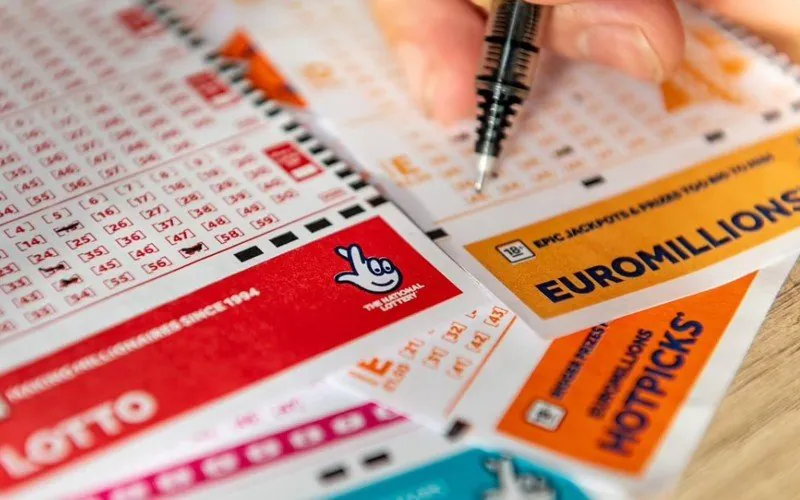
Now we will apply that formula to three of the most renowned lotteries in the world. The US Powerball, the UK National Lottery (lotto), and the EuroMillions – all of which have different conditions.
PowerBall Lottery
You have to select 5 white balls that range from 1 to 69, and a 6th ball, the Powerball, that ranges from 1 to 26. The ticket price is $2, and you can either pick the numbers yourself or have them selected at random by the operating machine. So then, we have to use the formula twice, once for the white balls and once for the Powerball, and then multiply these together.
For 5 white balls
- n = 69
- k = 5
- n! / k! (n-k)! = 69! / 5! (69 – 5)! = 69! / 5! x 64! = 11,238,513
Powerball
- n = 26
- k = 1
- n! / k! (n-k)! = 26! / 1! (26-1)! = 26! / 25! = 26
Multiplying the two we get
11,238,513 × 26 = 292,201,338
Therefore, your odds of winning at Powerball are 1 in over 292 million.

UK National Lottery (Lotto)
The National Lottery requires players to pick 6 numbers from a range of 1 to 59. The lottery costs £2 per ticket, and if you don’t pick the numbers yourself, you can use the automatic “Lucky Dip“. The top prize is won if you get all 6 numbers right, but if you match just 2, you will get a free Lotto Lucky Dip ticket for the following week. Matching anywhere between 3 and 5 numbers, and you can receive prizes of varying amounts.
- n = 59
- k = 6
- n! / k! (n-k)! = 59! / 6! x 53! = 45,057,474
The chances of winning the UK National Lottery are just 1 in over 45 million, but the jackpot prize is also considerably lower than the US Powerball.
EuroMillions
One of the most popular international lotteries is the EuroMillions. This lottery is run by the French, Spanish and UK lottery conglomerates, and is available across a wide array of European countries. The game works in the following way: you pick 5 main numbers from 1 to 50, and then two Lucky Star numbers from a pool of 1 to 12. Once again, just like the Powerball, we need to split the two different parts and then multiply them together.
5 Main Numbers
- n = 50
- k = 5
- n! / k! (n-k)! = 50! / 5! x 45! = 2,118,760
2 Lucky Star Numbers
- n = 12
- k = 2
- n! / k! (n-k)! = 12! / 2! x 10! = 66
Therefore, the total jackpot odds are
2,118,760 × 66 = 139,838,160
That is, 1 in over 139 million. The EuroMillions prizes are often a lot more than the UK National Lottery, but not nearly as much as the Powerball.
Common Lotto Misconceptions and Superstitions
The odds are stacked high against you, and the reality is that it doesn’t really matter which numbers you pick. However, a lot of players have built superstitions and rituals, in the hope that it may procure a moment of magic. The most common is having lucky numbers. You go every week with your lucky numbers, and one day fortune will come your way and snap them all up in one swoop.
Some players do the opposite. They change their numbers every week, perhaps thinking that by changing they are getting more coverage and not sticking with stale numbers. But the maths does not support either theory. Looking back, there will definitely be numbers that have cropped up frequently. This can prompt players to think these numbers may come more regularly, like a hot hand fallacy.
But the truth is that the draws are completely random, and there is no way of predicting what numbers will be drawn. Sure, some players may try to form patterns or read into anomalies or variance in the results. The last draws will have no affect whatsoever on the next ones, and any repeating numbers are just a statistical anomaly due to chance. You should avoid trying to make more of past results, as it can lead to a number of cognitive biases.
The only logical way of increasing your chances of winning is by buying more tickets. If you want to get a 50-50 chance of winning the UK National Lottery, you would need to buy 23 million tickets. That is, spend over £45 million, much more than the average max prize of £13 million.
How They Compare to Jackpot Casino Games
Jackpot casino games spark a similar type of hope and dopamine rush in players as lotteries. But the major difference is that you don’t need to hit the jackpot to make a profit off the games. A player can trigger a bonus round in a progressive slot and walk away with a major win, without hitting the main jackpot.
The main prize in a progressive slot can easily rival that of smaller or medium-sized lotteries. And, just like lotteries, they increase as more people play them.
However, the chances of a player getting addicted to the lottery are negligible. Sure, lotteries are a form of gambling, but they don’t have the same sensory overload as slots, for example. You won’t spend more than a couple of minutes buying your ticket. Whereas in slots, blackjack or roulette, you can spend hours playing round after round.
Are Lottery Games Rigged?
Most lotteries are run by the state, through governmental agencies, or state commissions. They are designed to create revenue for the government, which can be put towards infrastructure, education, and building social programs. Yet in some countries or regions, privately licensed companies have permission to run lotteries. The games must all be fair to play, and cannot be rigged in any way or form whatsoever.
Is Playing the Lottery Worth It
Lottery games have their own entertainment factor, and they are far safer to play than casino games. It only costs a few dollars a week, and it can crank up your excitement levels when watching the draw.
But if we are looking at lottery games from a purely pragmatic perspective, they are not worth it. To gain a 50-50 chance of winning the National Lottery, you need to buy £45 million’s worth of tickets. For a prize that on average is around £13 million. If you were to try buying half the tickets for the Powerball, you wouldn’t fare much better. It would cost nearly $150 million to increase your chance of winning to 50%. But on average, the Powerball top prize is around $145 million.
The chances are that most of us will never experience a real lottery jackpot win. Most lotteries have supplementary prizes, offered for hitting multiple correct numbers. However, given the tremendous odds against winning, you aren’t really allowed to get your hopes up. If you play, do so for the thrill of the draw.