Craps
Craps Bankroll Management: Stretching Your Funds for Longer Play

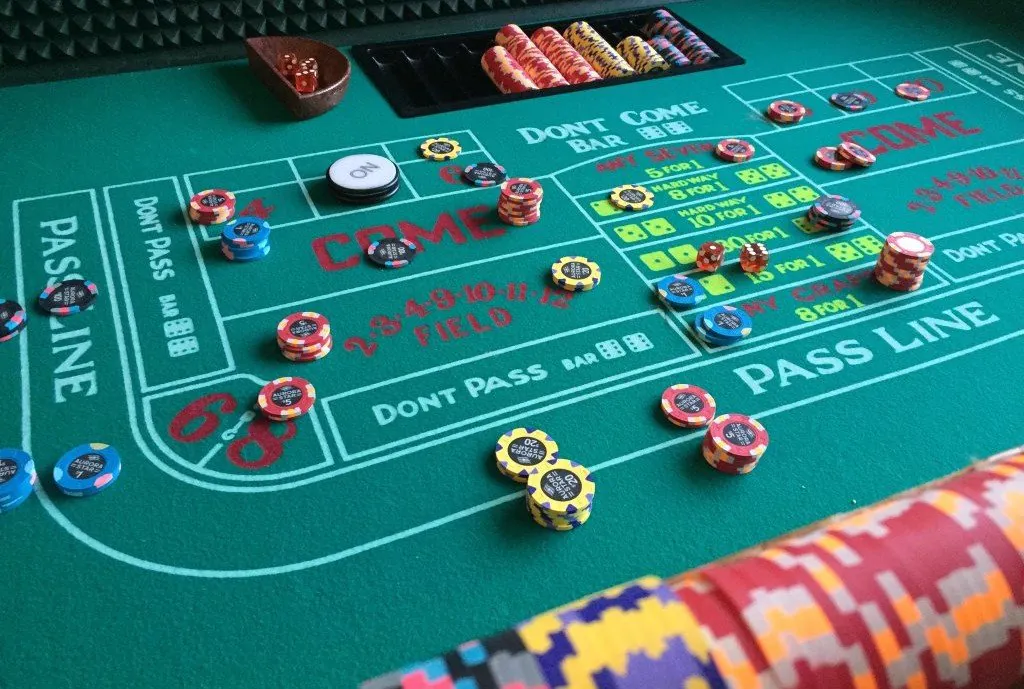
Craps is massively popular among expert players, and with a well built strategy, you can easily reach their level. The game involves betting on a pair of dice, with wagers that pay out from 1:1 up to 2:1, and many in between. One of the most attractive aspects of craps is that some of the bets have no house edge.
Players can diversify their wagers especially given if the dice must be re-rolled in a round. Though inexperienced or excited gamers can easily pile on the wagers and end up blowing through significant chunks of their bankroll in no time at all.
The best strategies for any casino game are usually designed for longterm play. In that, we mean that they require you to play a good number of hands or rounds to build your profit. This rules out all kinds of anomalies (good and bad), and enhances your chances of getting into the green. But before we can divulge into any of that, you will need a solid bankroll that can sustain longer periods of gameplay. And protect yourself from going bust.
Diversity of Craps Bets
The basic gameplay can be separated into the Come Roll, and the Point phase. The Come Roll is the first roll, before which, you can place your initial stake. This roll can either satisfy the Pass Line bets (7 or 11), crap out (2, 3, or 12), or they can make the Point phase (4, 5, 6, 8, 9 or 10).
Establishing the Point is the most common scenario, and if the round goes into the Point phase, this unlocks many more wagers. The Come and Don’t Come bets, Taking Odds, and Places to Win bets are unlocked. The Taking Odds bets are the ones we highlighted before, which have 0 house edge. This means the bets pay out to the exact probability of them actually happening. For example, there is exactly a 33.3% chance for the next roll to make 4 or 10. The betting odds are 2:1 -the same proportion.
Dangers of Craps Betting
You place one stake per round in games such as slots, roulette, and baccarat. Some variants may have gamble features or other extras that allow you to bet more than once per round, but these are not common. Blackjack and video poker are games in which you have the possibility to double up after the initial cards are drawn. And then, there are games such as poker in which you start with a buy in, and this can go all the way up to the table limits.
Craps is quite unique, as there is no obligation to raise your initial stake if there is going to be a reroll. However, you can if you want to. And taking into account the Taking Odds bets have 0 house edge, which can easily lead to bettors pumping in big money in short spaces of time.
If you are going to use Taking Odds or any other extra bets, you will need to count this in your bankroll. Creating a bankroll for craps is far more multifaceted than slots or roulette. With slots, you can just set the autoplay for 50 spins at $0.50 per spin ($25 in total). With craps, you need to be more savvy.

Managing Your Bankroll
The first rule of making a casino games bankroll is to never assume that it is an investment or you will make any profit. The money you top up your gaming account with is money that you will use to play the games. Therefore, never put money you cannot afford to lose into your gaming. A good practise is setting up a deposit limit, on a monthly, weekly, or even daily basis. This protects you from overspending, and from making any reckless decisions where your money is concerned.
Now that you have your limit, you can allocate it into each gaming session. We are not necessarily saying you will lose all your money in each session, but for practical purposes, don’t assume there will be any profits. Let’s say you have $100 to play with on a weekly basis. You generally play on weekends, therefore $50 for two gaming sessions.
If this were roulette, we could say that in 1 hour you could expect 100 spins on the wheel. For 1 hour of gaming, we would advise you to spend up to $0.50 per spin. But as the bets in craps are more multifaceted and rounds can stretch out a good 2, 3 or more rolls, you need to be a bit more cautious.
How it Works with Craps Taking Odds Bets
Generally, it is advise to place around 1-5% of your bankroll for each round. This means, your Saturday $50 funds will turn into $0.50 up to $2.50 per round. But that must count the Come Roll bets and any Point Phase rolls. If you want to take advantage of the zero house edge odds, then consider spreading out your stake per round across those bets.
- Come Roll – 1:1 with 1.41% House Edge
- Don’t Come – 1:1 with 1.36% House Edge
The Taking Odds have higher payouts with no house edge at all. However, they carry more risk than the Come and Don’t Come bets.
- 4 or 10 – 2:1 (33.3% Chance of Winning)
- 5 or 9 – 3:2 (40% Chance of Winning)
- 6 or 8 – 6:5 (45.5% Chance of Winning)
Therefore, it is advised to place a smaller stake of your money on these bets. With the 4 or 10 bets, you would break even if you won 1 from every 3 rolls. The 6 or 8 Taking Odds has the greatest chance of turning a profit, but the odds point towards you losing just over half of your bets. If you do win more than half, they are also quite slow to build a considerable profit.
So bear in mind the risk, and even if there is no house edge, the odds are still stacked against you with any of the Taking Odds bets. To cancel out any anomalies, you will need to play for longer periods of time. Craps can be very streaky, so play for the long haul to try to build a profit.
Observe Table Limits
You can find tables with all sorts of limits, from high stakes craps games to the ones that take pennies and cents. Don’t be afraid to start low, and hug the minimum stake line. If you are playing a conventional game of craps, you are not playing to hit big jackpots. Your main goal is to keep afloat and stick in the game until you have reached your goal.

Set Loss and Win Markers
This is vitally important for all casino gamers. Setting loss and win markers helps you track your progress and stay ahead of your spending. As the main bets in Craps pay 1:1, it is quite easy to go a full hour and have a bankroll of +5% or -5% from what you started with. It feels like you have made no progress at all, but that is not true.
The time for each round varies heavily, depending on whether the Point is established, whether you place additional bets, and various other factors. But it is quite easy to imagine you play around 60 rounds in an hour, of which 40 go to the point phase and require 1-2 additional rolls. Over such a long period of time, you may have easily spent 50% of your bankroll.
But the returns have balanced your spending, therefore hiding how much you have actually spent. It also hides the fact that you won 45-55% of your bankroll. After the hour, you may take the fact that you are nearly at your starting position as affirmation to continue playing. After all, you have neither gone bust nor have doubled up on your original bankroll. This is one of the many common gambler’s fallacies that players can fall into without having a good strategy in place. Set those win and loss limits, and always keep track of how much your gross spending and gross wins.
Applying Betting Strategies in Craps
You don’t really have any influence on the outcome of a dice roll, even if you are the one throwing. The physics behind the dice roll, the table surface, and the rules of how to roll make it virtually impossible to cheat. But you do have influence on how you can place your bets and how much you stake per round.
These are the areas that expert players use to build strong betting strategies. You can always keep things simple, and flat bet Craps. That means, using a fixed stake per round and never deviating from it.
You can also use progressive betting sequences to change your stake depending on whether you won or lost the last round. The most notable of these is the Martingale system, by which you double your stake after each loss. When you finally do win, you will make back all your losses. However, it means that you will need a tremendous bankroll to keep going.
Alternative Progressive Betting Systems
There are loads of betting systems that you can use in your craps gaming. The Martingale is just the most famous of these systems, but you can also apply the Reverse Martingale, D’Alembert, Labouchere, Fibonacci, and various others. Not all are positive progressive systems. For example, the Paroli system is like the Martingale in that you double up after a loss, but after 3 losses you reset. The Labouchere system involves you increasing your stake after a loss, but also decreasing it after a win. Thus, you will negate your losses but also curb your winning potential.
The Fibonacci system is similar to the Labouchere, involving you increasing and decreasing your stake after wins and losses. However, you have to make units from your bankroll, and increase/decrease them according to the Fibonacci sequence numbers. That means, going up 1, 1, 3, 5, 8, 13, and so on. Winning, you move up 1 place up the sequence, and when you lose you move a step down.
Summarizing Your Craps Bankroll
The betting systems all vary depending on what you want to achieve. The Martingale is highly effective if you are pursuing wins at any cost. But you will need a gigantic budget, and to start with less than 1% of your stake. Using the Labouchere will help you keep a balanced bankroll, reducing the chances of heavy losses. However, it does not actively hunt for the big wins. Instead, it just ensures you don’t fall victim to losing streaks or push too hard on winning streaks.
Players are encouraged to personalize these systems and adapt them. They are quite easy to understand and can be adjusted to fit virtually any budget. With a solid bankroll and a good system in place, you should be able to enhance your chances of turning a profit on craps. Just remember, to play for fun and never take losses personally. You will win some and lose some, just keep a level head and an eye on your spending.




