Blackjack
Blackjack vs Spanish 21: What’s the Difference?

 Add Gaming.net to your preferred sources on Google
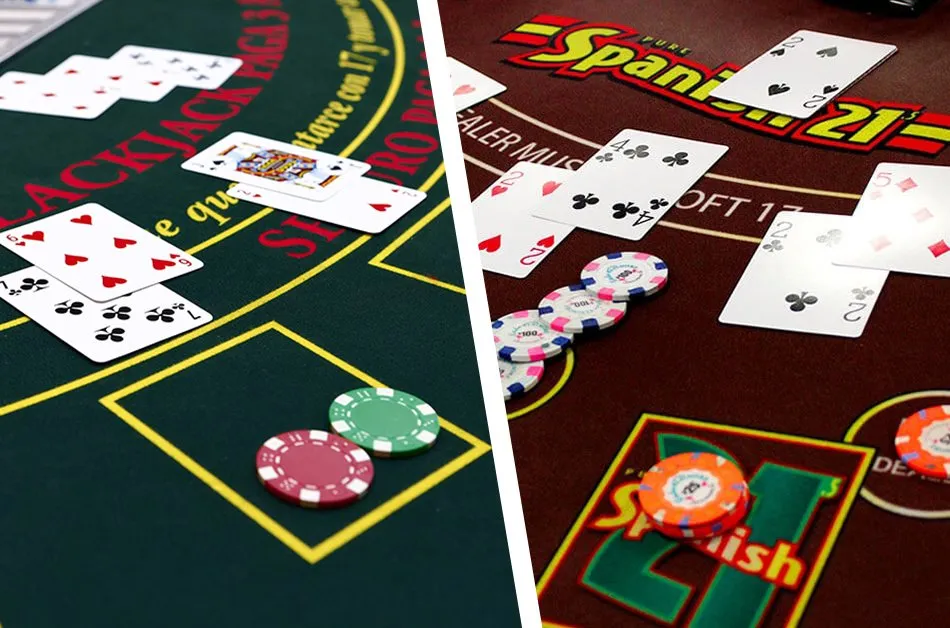
The gambling industry can be very alluring, especially for novice gamblers. The reason is the fact it offers a lot — from a promise of a great time, to the potential to win massive amounts of money, provided that you are lucky and that you know what you are doing. Depending on the game you choose, you might need only one of these, or you might need both, which is why novice gamblers like to compare games and learn which ones can give them the most money if they win, while making the winning as easy and as possible.
Slots, for example, are a game where there is zero skill required, and you require on luck alone, 100%. All it takes is pulling a lever, and having enough money to keep adding it to the machine until you win. On the other hand, poker requires 90% of skill and 10% of luck in order to win. That makes it best for professional, competitive gamblers.
Most novices, however, choose to go for something in the middle of the two — games where they can have some level of control of the outcome, but that do not put all the responsibility on them, which leads them to games such as blackjack or Spanish 21. With that said, we wanted to compare the two games and see which one is better.
Blackjack vs Spanish 21: The difference between the two games
The first thing to note about these two games is that they are actually close cousins, with Spanish 21 offering increased payments, but also a certain twist that results in all the 10 cards being removed from the deck. That way, players are significantly more likely to hit blackjack.
Apart from that, there are a few more differences that players can benefit from. One of them revolves around the fact that players can just surrender in Spanish 21 and give up their hand, which is something like folding in poker. How does this help, you might ask? Well, if you decide to give up, you get half of your bet back. This is a useful thing to do if you notice that things are not going well, and you decide that you are ready to cut your losses and try a new round.
However, keep in mind that only “late” surrender will be accepted, which means that you can only do it after the dealer has checked to see if he has a blackjack. Apart from that, Spanish 21 also lets you double down after splitting. If you know blackjack, you know that you can usually split and play on in the majority of blackjack versions. But, in Spanish 21, you can split and double down if you choose, which is what players typically opt to do when they get two aces.
Speaking of aces, if you happen to split them and land yet another ace, you can also re-split, which allows you to put extra money on the table. And, while the 10s are removed, the picture cards remain, which means that there are still plenty of options to make 21.
This leads us to another difference between the two games. You see, when the dealer hits 21 in blackjack, you must push. In Spanish 21, however, if you happen to get 21, you win automatically. And, if you and the dealer happen to get to 21 simultaneously, this is another win for you.
Finally, one last rule to remember is that Spanish 21 lets you double down after any number of cards dealt, unlike in blackjack, where you can only do so after receiving your first two cards.
What are the odds?
Next, let’s talk about the odds in blackjack and Spanish 21. In regular blackjack, you always get a 1:1 payout, with the only exception being if you hit a natural 21 with only the first 2 cards, which is not impossible, but it is pretty rare. Spanish 21, however, is a lot more rewarding, allowing for different scenarios.
For example, you can:
- Make 21 with a 5-card hand for a 3:2 payout
- Make 21 with a 6-card hand for a 2:1 payout
- Make 21 with a 7-card hand for a 3:1 payout
- Make 21 with 6, 7, 8 for a 3:2 payout
- Make 21 with three 7s for a 3:2 payout
- Either of the mentioned three-card hands suited will secure a 2:1 payout
- Either of the mentioned three-card hands in spades secure a 3:1 payout
Note that this may be different from one casino to the next, depending on a number of factors, such as the number of decks, whether or not the player has to hit on soft 17, and alike.
The house edge
Another thing to consider when comparing these two games is the house edge. For example, blackjack players who know what they are doing can expect the house edge to be anywhere up to 4.5%. With a good enough strategy, they can get the edge down all the way to 0.5%, which is pretty much the lowest percentage in the house’s favor in all casino games out there, as it means that you lose 50 cents for every $100 that you bet.
In Spanish 21, however, experts can do just a little bit better and reduce the house edge to 0.4%. Note that this is a challenging thing to do, and the player needs to be an expert with a sound strategy and enough discipline to stick to it. The good news, however, is that the strategy is simpler than blackjack strategies.
Spanish 21: Surprisingly difficult to find
One last difference between the two games lies in the fact that blackjack is everywhere, all over every casino. Spanish 21, however, can be challenging to find. So, if you just want a variant of the 21 game, then blackjack is your best bet. If you want actual Spanish 21 for all its benefits, you might need to do some research in order to find its table, as bumping into it randomly doesn’t happen so often.




