News
Nvidia DLSS 5 Launches September 3 in NBA 2K27 for RTX 50 Series

 Add Gaming.net to your preferred sources on Google
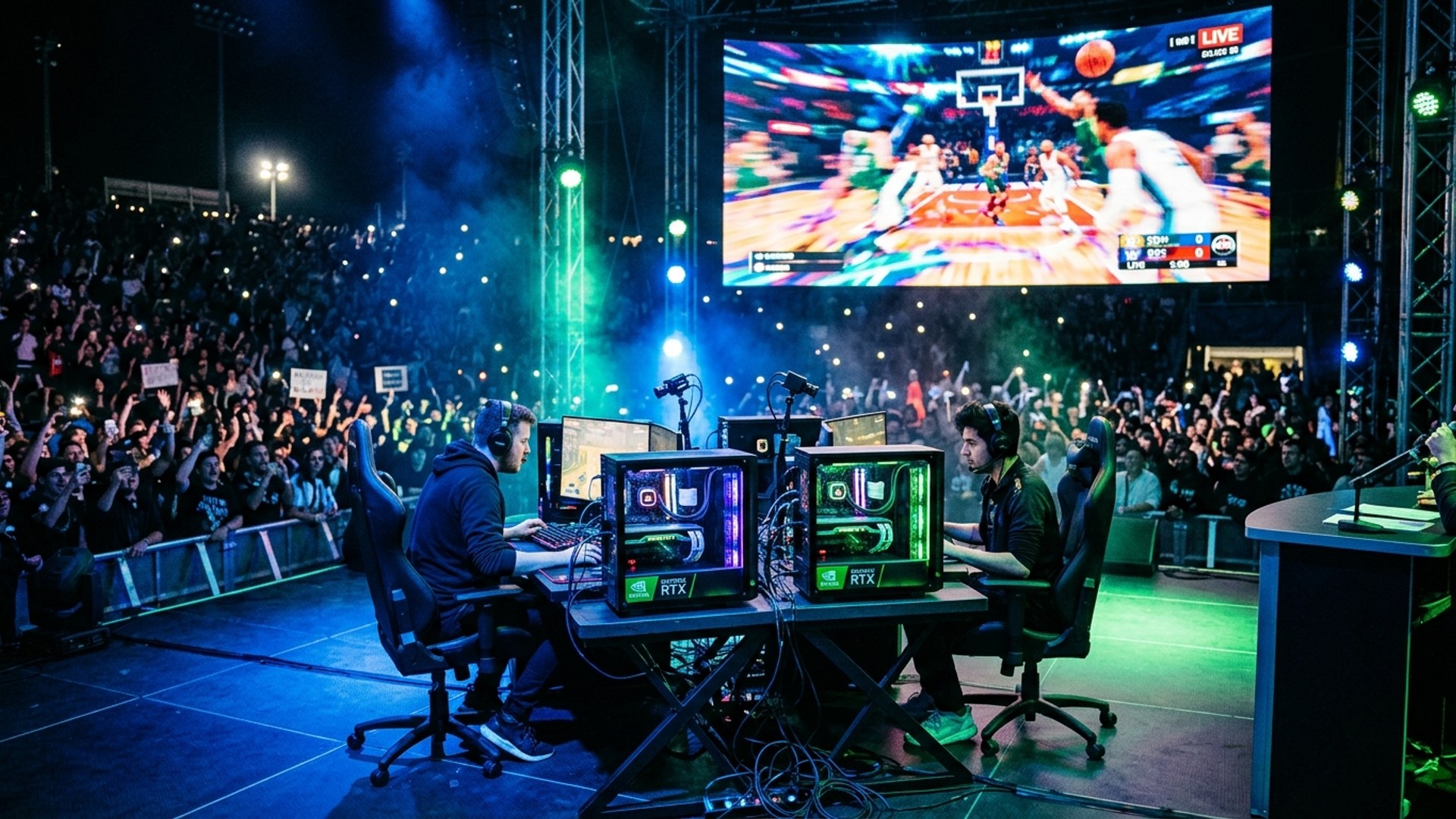
Nvidia will release DLSS 5, its 3D-Guided Neural Rendering technology, on September 3, 2026 at 9 p.m. Pacific Time, debuting in Visual Concepts and 2K’s NBA 2K27 for all GeForce RTX 50 Series desktop and laptop GPUs and on GeForce NOW. The company detailed the launch on September 1, 2026, calling the technology a new rendering stage that uses AI to generate lighting and material detail anchored to each game’s rendered frame.
DLSS 5 moves the DLSS line beyond performance reconstruction. While earlier DLSS technologies focused on higher-resolution images, generated frames, or cleaner ray-traced lighting, Nvidia says the new model generates the lighting and material detail that real-time performance budgets previously forced developers to cut. The system takes the game engine’s rendered frame, including its geometry, textures, and lighting buffers, as its foundation, and Nvidia describes DLSS 5 as the final rendering stage of the graphics pipeline.
How the Neural Rendering Model Works
Nvidia says it built a new real-time AI model around three engineering requirements: preserving artistic intent, guaranteeing temporal stability, and running in milliseconds. The model operates deterministically, producing consistent output for identical input frames, and is trained to recognize engine data such as color, surface albedo, detailed lighting, and surface normals. Nvidia says the model adds lifelike material interactions including skin subsurface scattering, light transmission through hair and foliage, deeper contact shadows, and global illumination.
For frame-to-frame consistency, DLSS 5 runs on a one-frame-in, one-frame-out model and uses motion vectors directly from the game engine, which Nvidia says eliminates shimmering, swimming, and temporal drift during player movement. The compact network runs locally on a single GeForce RTX 50 Series GPU using the cards’ Tensor Cores, maintaining frame rates at up to 4K resolution, according to the company.
Developer integration uses the existing Nvidia Streamline framework and an Unreal Engine 5 plugin. DLSS 5 operates as an optional, independent feature that studios can enable alongside Super Resolution, Multi Frame Generation, and Ray Reconstruction. For players, it appears as a single on-off toggle.
Developer Controls and Artistic Direction
Through the DLSS 5 SDK, developers can choose between several models with different parameter weights, applying one model across an entire game or mixing models between scenes, gameplay, and cutscenes. Structure Intensity and Tone Intensity adjustments control high-frequency details such as ambient occlusion and reflections, and broader lighting and color response respectively; setting Tone Intensity to zero preserves the exact colors of the rendered frame.
The toolset also includes semantic AI masking, which automatically recognizes scene objects so developers can increase environmental enhancement while holding back on characters, or the reverse. Engine-level masking lets artists isolate specific props or asset groups, such as glassware or foliage, for separate treatment. Nvidia says the output remains grounded in the engine’s base frame, so final quality scales with the fidelity of the game’s input, with ray-traced or path-traced source data producing more accurate results.
NBA 2K27 Implementation and Performance
Visual Concepts, which has developed the NBA 2K series for over 25 years, uses DLSS 5 to tune lighting and materials while preserving facial geometry scanned from real-world athletes, according to Nvidia. The company published comparison images of players including Cade Cunningham, Tyrese Haliburton, and Jayson Tatum, describing effects such as warmer skin under arena lighting and tighter contact shadows along jerseys and collars, with courtside spectators and staff receiving similar treatment.
“DLSS 3D-guided neural rendering helped boost the visual quality of our materials and lighting, bringing a real jump to photorealism across the game,” said Peter Kavic, Senior Producer at Visual Concepts.
Nvidia’s own performance charts claim that at 4K with the Ultra Preset and ray tracing, GeForce RTX 5090 owners can play at up to 370 frames per second with DLSS 5. At 2560×1440, the company lists up to 590 frames per second on the RTX 5090, up to 410 on the RTX 5080, up to 350 on the RTX 5070 Ti, and up to 260 on the RTX 5070. At 1920×1080, Nvidia says virtually all GeForce RTX 50 Series owners can run the game with ray tracing and the Ultra Preset alongside DLSS 5.
GeForce NOW Ultimate members will access DLSS 5 by streaming from Nvidia-operated GeForce RTX 5080-powered rigs in the cloud.
Driver Requirement and Roadmap
Enabling DLSS 5 in NBA 2K27 requires a new GeForce Game Ready Driver, also launching September 3, 2026 at 9 p.m. Pacific Time through Nvidia’s website or the Nvidia app. In-game, players select Video Settings and turn on DLSS Neural Rendering, with the option to toggle it during gameplay and replays using the F9 key.
Nvidia says that since DLSS 5’s initial announcement in March, it has moved the technology from running on dual GeForce RTX 5090s to a single graphics card, a 5X performance gain in six months achieved through pipeline optimizations and neural model refinements. The company says further model updates expected in the fall will boost performance beyond the current baseline, and that additional titles integrating DLSS 5 will be announced in the coming weeks and months.