Technology
Ramen Open-Sources Aura Autopilot to Bring AI Playtesting to Unreal, Unity and Godot

 Add Gaming.net to your preferred sources on Google
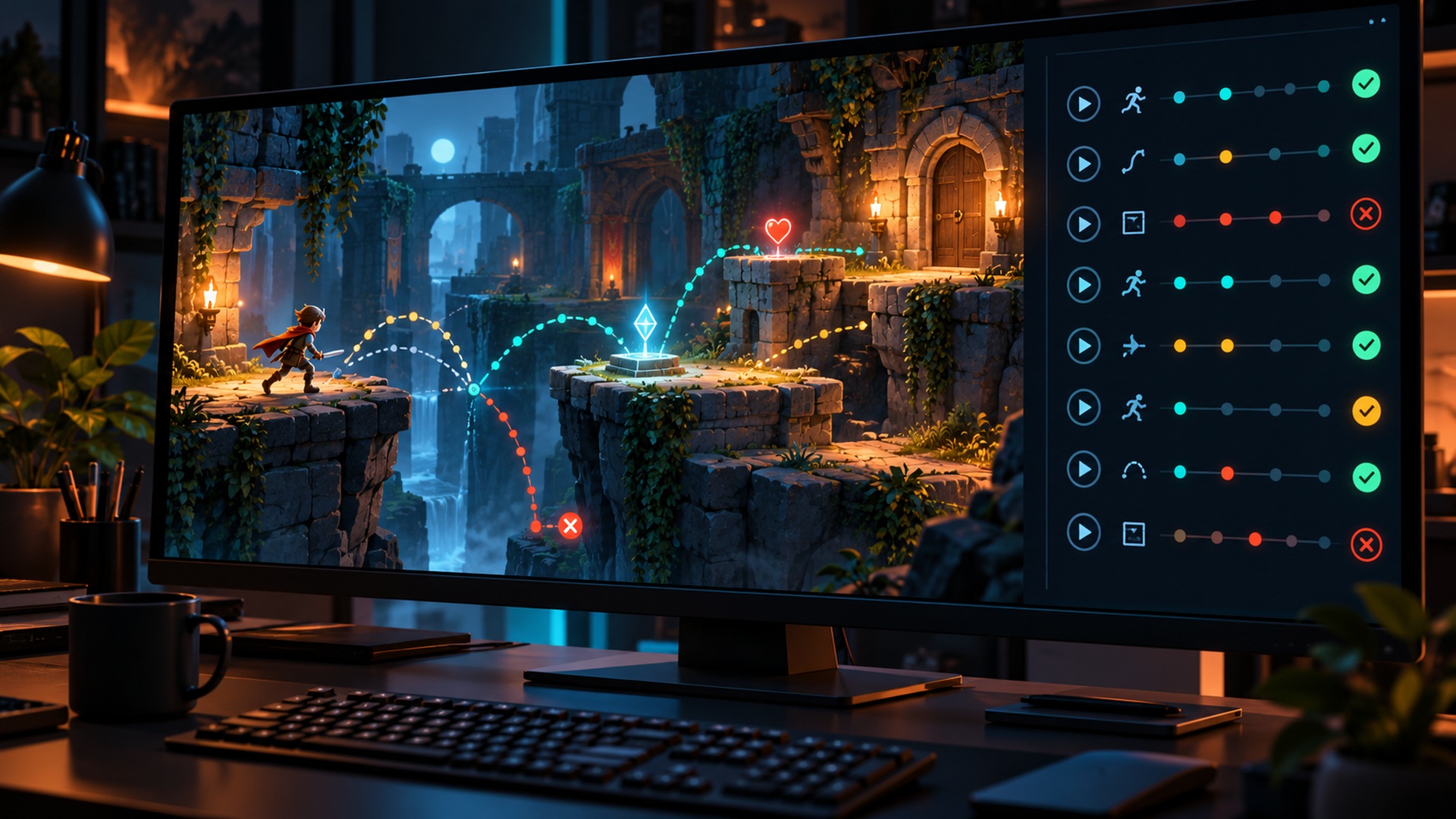
A game can compile cleanly and still have a broken jump, an unreachable objective, or a menu that never closes. Ramen is targeting that gap with Aura Autopilot, an open-source game-playing agent announced on October 30 for Unreal Engine, Unity, and Godot. The tool is designed to learn a game while playing it, pursue longer-term objectives, and let developers direct its attention toward particular systems.
The announcement extends Aura, Ramen’s existing multi-agent development assistant for Unreal and Unity. The proposed workflow joins two activities that often remain separate: one agent builds a gameplay feature, and another enters the game to test whether the feature actually works. For studios, the significance lies in shortening that feedback loop without making a developer personally repeat every basic interaction after each change.
Why Playing the Game Adds Something Code Checks Cannot
Compilation establishes that code meets a language’s rules. It does not establish that a player can finish a quest or that a stamina bar drains at the intended rate. Those outcomes depend on systems interacting over time: inputs, physics, animation, game state, interface elements, and sometimes multiple connected players.
Ramen’s documentation for Aura’s existing Verification Agent makes that distinction concrete. In Unreal, it launches Play-In-Editor, inspects runtime information such as spawned actors, ability attributes and interface visibility, and can attach recorded video as evidence. It can attempt a repair and run verification again. The documented Unity implementation is simpler: it compiles, enters Play mode, and checks screenshots, without the same advanced video-evidence features.
Autopilot is the newly announced playtesting agent, so those existing capabilities provide context rather than proof that every engine has identical functionality. Ramen says Autopilot can play across shooters, action RPGs, mobile games, survival crafting, turn-based JRPGs, and real-time strategy games. That is a claim about the range of its early demonstrations, not evidence that every commercial game or unusual control scheme will work without adjustment.
Steerable Testing Matters More Than an AI Winning a Demo
For development teams, a useful game-playing agent needs to do more than survive a level. It needs to investigate the behavior a developer cares about. Ramen describes Autopilot as steerable, allowing a team to focus it on a particular system while it plans toward longer-term goals.
Consider a hypothetical inventory change. A meaningful test might require finding an item, collecting it, opening the inventory, equipping it, and checking that the character’s behavior changes. That chain is more informative than seeing an inventory window appear. It also creates several opportunities for a failure that a narrow scripted check might miss.
The practical implication is that developers will need to write clear objectives and acceptance conditions. “Test the inventory” leaves considerable room for interpretation. “Collect this item, equip it, and confirm the damage value changes” gives an agent an observable result. Teams still need evidence showing what was attempted and what happened; a fluent success message alone is insufficient.
What “Self-Improving” Establishes—and What It Leaves Open
“Aura Autopilot plays any game in real time and learns as it goes, getting better the more it plays,” Ramen CEO and co-founder Andy Tsen said in the announcement. “That opens a new frontier for game QA, and we’re open sourcing it so developers and researchers can take it further.”
Ramen describes the agent as recursively self-improving and says it returns results faster as it gains experience with a game. The release does not specify whether that improvement comes from persistent memory, revised strategies, generated tooling, model training, or some combination. Those mechanisms have different implications for reproducibility, cost, and how well lessons survive a major game update.
A testing system that adapts can be useful when objectives and environments change, but adaptation also complicates comparisons between runs. Studios evaluating the tool should preserve the game build, model configuration, objective, and starting conditions alongside the result. That makes it easier to distinguish a fixed bug from a different route through the level.
Open Source Separates the Testing Layer From One Model Provider
Ramen says the standalone Autopilot works with existing Claude Code and Codex subscriptions or a developer’s own API key. It is also being integrated into Aura subscriptions. The announced GitHub project gives studios and researchers a place to inspect and extend the testing layer rather than requiring every team to build that infrastructure independently.
That flexibility could help studios compare models against their own games and choose a balance of latency, reliability, and cost. A fast model might handle simple interactions well but struggle with an objective that requires remembering several earlier decisions. A more capable model may improve completion rates while increasing the cost of repeated runs. Open-source availability does not remove model charges or the compute needed to run the game.
The distinction between Autopilot and the broader Aura product also matters. The announcement lists Unreal, Unity, and Godot for the testing agent, while Aura’s wider development assistant remains focused on Unreal and Unity. Godot support for Autopilot should not be read as a claim that every Aura creation tool is now available in Godot.
Reading the Performance Claims in Context
Ramen reports that Autopilot runs three times faster than its earlier Verification Agent at lower cost, and says its game-testing results outperform Bezi, NeoStack, Claude Code, and Codex. The company plans an accompanying whitepaper covering architecture and benchmarks.
Those figures are company-reported. The advance materials supplied for this article do not include the complete benchmark methodology, task set, model versions, failure criteria, or cost calculations. Consequently, the results do not establish an across-the-board advantage for every studio’s workflow. A useful production evaluation would compare successful test completion, missed defects, false alarms, runtime, and total model cost on the same builds.
Faster Iteration Still Needs Human QA
Automated playtesting could make repeated checks more accessible to small teams and give larger studios another way to exercise changing builds. It is particularly attractive when the same sequence must be repeated after many small changes. It is less suited to deciding whether combat feels satisfying, a tutorial is welcoming, or a story moment lands emotionally.
Ramen is expanding creation tools alongside testing: the announcement includes Figma and Blender integrations, prompt-driven character animation, and a revised level-design agent for larger blockouts. More rapid content generation increases the importance of checking the resulting interactions. The value of a build-and-test loop is not simply producing more assets; it is catching mistakes before those assets and systems become harder to untangle.
Ramen’s background helps explain that focus. The former VR studio built Zenith before moving into developer tools, and says its 2026 acquisition of Coplay strengthened Aura’s Unity capabilities. Autopilot brings that strategy into sharper view: AI that can help create a game also needs a dependable way to examine the game it created. For players, the eventual benefit would be fewer broken interactions reaching a release—not a substitute for the people who judge whether the experience is worth playing.