News
Union Files Labor Charge Over Microsoft’s Xbox Layoffs

 Add Gaming.net to your preferred sources on Google

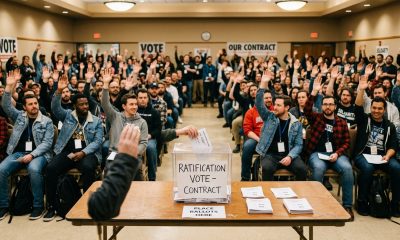
Microsoft’s Xbox overhaul has drawn a legal challenge it will not settle quickly. The Communications Workers of America filed an unfair labor practice charge against Microsoft (MSFT ) on July 15, 2026, accusing the company of cutting unionized developers without the bargaining that federal labor law requires. The filing turns a restructuring the company announced on July 6, 2026 — a plan to eliminate about 3,200 Xbox jobs, roughly 1,600 of them immediately — into a formal dispute before the National Labor Relations Board.
The charge, lodged with the board’s Fort Worth regional office, names Microsoft, Xbox and seven ZeniMax studios and units — among them Bethesda Game Studios, id Software and ZeniMax Online Studios — as joint employers. It alleges the company refused to hand over information the union requested, imposed unilateral changes on union members’ working conditions, bargained in bad faith, and engaged in coercive surveillance.
The bargaining fight at the center of the case
The dispute turns on a single distinction: what Microsoft had to negotiate, and when. The union argues the company was legally obliged to bargain over the layoff decision itself before carrying it out, because several Xbox studios are still negotiating their first union contracts. An employer cannot unilaterally change working conditions — and eliminating jobs counts — while those talks are live.
Microsoft’s public stance points somewhere narrower. In a statement to Game Developer, which first reported the filing, Xbox said it had “reached out to the union to begin effects bargaining and are committed to that process.” Effects bargaining covers the fallout of a layoff — severance, recall rights, internal transfers — not whether the layoff happens at all. The distance between negotiating the decision and negotiating its consequences is the entire case.
CWA Canada, which represents Bethesda’s Montreal staff, filed a parallel complaint north of the border, where its president said Microsoft ousted employees without notice or discussion while a collective agreement was still being negotiated. The union has also said the cuts decimated teams at id Software, Bethesda and ZeniMax Online — the studios behind Doom, Quake, The Elder Scrolls and Fallout — draining engine expertise and institutional knowledge the remaining staff will struggle to replace.
How the Activision deal set this up
The fight traces back to the concession that helped Microsoft close its largest acquisition. To ease regulatory approval of its roughly $69 billion purchase of Activision Blizzard , the company signed a labor-neutrality agreement with the union in 2022, promising not to oppose organizing across its games business. The pledge worked as designed: more than 3,500 Xbox workers have unionized since, the union says, on teams behind franchises including The Elder Scrolls, Diablo and Overwatch.
What the framework never set was a deadline for reaching a first contract. So when the cuts came, many newly organized units — at Bethesda, id Software and ZeniMax Online — were still at the table, without the advance-notice and recall rights a ratified contract would have secured. Roughly 440 of the eliminated roles were union-represented, according to the union, and workers protested at six studio locations across the US and Canada on the day the charge was filed.
Claude Cummings Jr., the union’s president, said members had been “extremely disappointed by a company that has slow-walked our members at the bargaining table, making CWA members wait for the protections of a union contract.” Groups that did reach agreements before the layoffs landed — including a ZeniMax quality-assurance unit — went in with enforceable notice and recall terms the newer units lacked. It is not the union’s first labor complaint against a Microsoft games business; the two sides have clashed repeatedly since the studios began organizing.
What it means for the reset
The charge lands as a cost and reputational drag on a restructuring CEO Asha Sharma has framed as unavoidable. The cuts erased about a fifth of the Xbox workforce and set five studios up for divestiture, following months of margin pressure and a Game Pass business that came in well under internal targets. Sharma has told staff the division’s bets failed to grow as fast as expected and that Xbox needed to reset.
For all the noise, the labor board offers limited firepower. Its investigators will decide whether the charge has merit and whether to issue a complaint; the strongest remedies are reinstatement and back pay, not a reversal of corporate strategy. The union cannot force Microsoft to rehire the workers or unwind the divestitures. What it can do is press for better severance, transfers and recall — and build a record that a company which promised to be a model employer to win its Activision deal broke federal labor law while dismantling the studios it bought.
That record is the real exposure. Microsoft spent two years and tens of billions arguing it would be a responsible owner of the industry’s biggest studios. A federal finding that it cut their staff illegally would test how much that promise was worth.