Technology
Nexus Mods Expands AI Rules but Rejects an Outright Ban

 Add Gaming.net to your preferred sources on Google
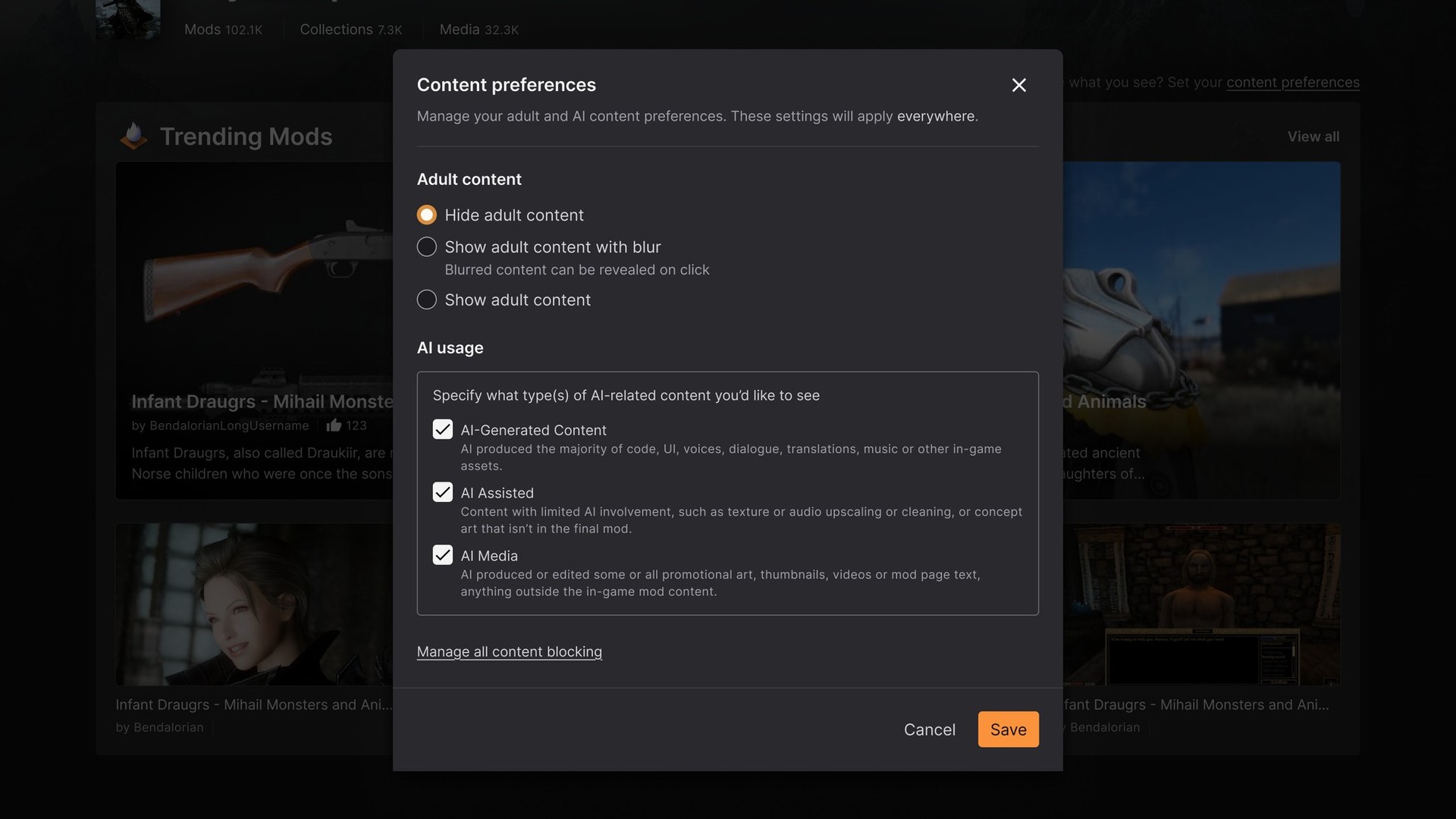
Nexus Mods announced revised AI rules on November 3, 2026, rejecting an outright ban on AI-generated mods while expanding disclosure, creator permissions and discovery controls. New uploads must declare AI use immediately, and existing mods have until January 2, 2027 to meet the requirements covered by a 60-day transition.
The platform’s rationale is that AI can appear throughout creation, from script autocompletion to generated textures, voices and complete assets, leaving no clean line between acceptable and unacceptable use. On that reasoning, a ban would discourage authors from mentioning AI rather than remove it from modding. AI-generated mods therefore remain welcome, subject to rules on permissions, transparency, presentation and conduct.
Nexus Mods also committed not to use hosted mods to train AI, or to sell or license them to anyone for that purpose. The pledge accompanies new settings intended to give individual authors more control over training, automated generative workflows and forks.
The decision formalises a position Nexus Mods set out on April 27, 2023: AI-generated mod content did not itself break site rules, but could be removed following a credible complaint from an affected creator or rights holder. That statement planned no submission-guideline changes.
What Authors Must Disclose
The companion AI Policy Changes 2026 document divides disclosure into AI Generated Content, where AI produced core code, voices, textures, text or scripts; AI Media, for promotional material outside the game files; and AI Assisted Content, for human-led projects where AI played a supporting role. AI tags will also be displayed immediately after adult-content tags to make them easier to spot.
AI-assisted pages must name the tools, software or models used and identify exactly which AI outputs remain in the finished mod. Authors must also provide evidence such as project or version-control history and human-led design, and may have to demonstrate understanding of their code during moderation disputes. Public statements must be updated when later releases add or substantially change AI-assisted components.
Separate settings for AI Training/Tool Usage and Forks/Parallel Versions will default to “Ask Me,” including on legacy files. That setting requires direct written permission for covered training, fine-tuning, dataset compilation, automated generative workflows and project forks. Existing rules for conventional asset reuse, conversions, ports and reuploads remain unchanged, while valid copyleft licences that permit derivatives and impose share-alike terms take precedence over platform defaults.
Forks or variants of actively maintained mods require documented permission unless the original page expressly allows them. Derivative works must visibly credit every original creator in the chain and link to the original mod or external source.
Discovery, Rewards and Enforcement
Users are getting AI content-preference controls on game pages and the homepage, with search and game-homepage display controls to follow. Nexus Mods also plans to trial per-author limits in Recently Added and tighten upload restrictions for newly created accounts, addressing concerns that rapid uploads can push other work down the page. AI images passed off as genuine in-game shots will be treated as misrepresenting a mod; the announcement adds no extra restrictions for gray areas such as text overlays, enhancement or artwork for non-visual mods.
Nexus Mods reported that mods carrying the AI-Generated Content tag received 2.13% of all Donation Points in 2026 up to the announcement. The announcement leaves the reward rules unchanged.
Its concern is that removing earnings after disclosure could discourage honesty, particularly because Donation Points affect both recognition and income. Unauthorised forks are treated differently: content using another author’s work without permission will not be hosted.
Nexus Mods reported 3,164 manually reviewed and cleared uploads among those made between November 2025 and October 2026, more than four times the previous annual figure, plus 20,000 quarantined uploads over the year preceding the announcement, 12 times the previous annual figure. Staff may request source code when safety or undisclosed-behaviour concerns remain unresolved; authors are not obliged to supply it, but hosting can be discontinued if those concerns cannot be settled.
The transition applies only to the detailed AI-assisted statements and mandatory fork/AI permission tags. Basic AI disclosure, copyright and core site rules remain enforced, and new uploads must complete the updated fields immediately. After the deadline, authors will be notified to correct missing disclosures or permissions; continued failure after staff notification will result in moderation action, account restrictions, warnings or removal from the platform.
Nexus Mods cautioned that identifying AI-generated content is not an exact science. Initial enforcement will rely heavily on manual moderation and community reports, leaving scope for missed or incorrectly tagged content.
The result is a disclosure regime rather than an attempt to prove every mod’s origin. Authors keep a route to publish AI work, but must document it and define how it can be reused; users get more ways to avoid it. Accurate self-reporting, manual review and community reports therefore carry the practical burden of making those labels trustworthy.