Reviews
Turnip Mountain Review (Xbox Series X|S & PC)


I had low expectations for Turnip Mountain. Without the context, I made a bold assumption that it would be “just another Bennett clone” with irritating mechanics and god-awful physics, and that it would more than likely infuriate me than give me something to write home about. But I was wrong to judge it, for it wasn’t just another shameless cash grab that was desperately trying to steal that bitter nectar from Bennett, but a genuinely well-rounded, albeit visually minimalistic climbing game that had a good amount going for it.
I had to give it a nod of appreciation, because at the end of the day, it isn’t all that often that you find a game that utilizes the power of two mice to create a control system. But in Turnip Mountain, dual mice are the common ingredient. Rather than having you tap various WASD keys and forcing you to adopt the standard layout, Turnip Mountain asks that you plug in two mice, and then use each of them as separate hands to ascend a pixel-crafted tower of bubblegum pinks and dark blues. It might not be the first game to wield a double-sided configuration, but it is one that adopts it well and uses it to its advantage.

As the title implies, Turnip Mountain is, above all else, a climbing game that invites you to take control of an anthropomorphic turnip with two bulky arms and ascend a plethora of static two-dimensional tiers. With each mouse controlling an arm, you essentially have the task of alternating between both limbs and using a mixture of strength and strategic planning to vault, climb, and pivot to the apex. There are coins to collect along the way, skins to unlock, and multiple routes to explore. In short, though, it’s a simple affair that doesn’t leave a lot to the imagination. A jacked-up turnip craves the thought of reaching the pinnacle, and it wants you to reveal the route.
To simulate the feeling of climbing, Turnip Mountain grants you the opportunity to transform each mouse into fully functional, flexible tools that can allow you to forge paths and sink your prickly fingers into each hook. Alone, it’s a challenging, albeit rewarding affair that gives you a lot to work with. But with a friend, it becomes a strenuous and oftentimes painful process that requires perfect timing, careful world analysis, and a bond that is nigh on impenetrable. Given that you each have a hand to work with, both you and a friend must work in unison to tackle obstacles and find the appropriate anchor point. It’s a nightmare to learn I’ll admit, but it’s also surprisingly satisfying to master.

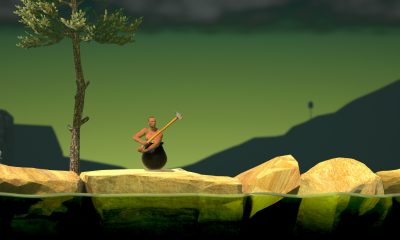
I won’t pretend that I didn’t suffer from a bad habit of placing one arm in the wrong socket on numerous occasions, because I did, and I had the battle scars to show for it. Given that Turnip Mountain was, of course, designed to test your reaction speeds and your mettle, it did leave me feeling battered, bruised, and without a trace of happiness on more occasions than I’d like to admit. Although not quite as perilous or as infuriating as Getting Over It, it did leave me itching for a spot of respite. If, say, I missed a long jump, or if I accidentally failed to bury my oversized fists into the wall, then I would have to retrace my steps and, well, do it all over again. And that brought a lot of stress.
The level designs were both a blessing and a curse. On the one hand, I had a plethora of arcade-like biomes that were evidently rife with creative ideas and puzzle pieces. But on the other hand, I had a hurricane that was simply waiting for me to make the smallest error. The quirky chiptune-like soundtrack might have aided the overall mood and relieved the tension, but its contagiously positive tone also made me want to take a mallet to the mouse and abandon all hope. But that was a classic rage-like technique — to overcompensate for the lack of transparency in the control system. It drove me crazy, but at least it gave me something to listen to whilst I descended further and further into madness.

The downside to all of the above is that, controls and popping soundtrack aside, Turnip Mountain is a short game that lacks the full weight of a broad campaign. That being said, with enough creative ideas, custom skins, and multiplayer options to choose from, it does supply a thoughtful and thoroughly enjoyable game that is, while still a pain in the neck even during the best of times, an absolute blast to play through. With a friend at your side, it’s even better. As equally painful and headache-inducing — but still a great deal of fun to gradually clamber through.
Verdict

Turnip Mountain is a lot more than a rage-baiting emulation of a cheap Getting Over It game, as it tries to overhaul a dated formula to introduce its own set of rules and mechanics. With two mice, it simulates the act of climbing in a way that feels both natural and, on occasion, surprisingly challenging. And with a sizable collection of stages to hone and ultimately flaunt its capabilities, it thankfully sticks around long enough to take full advantage of its unique features and present them in a way that compliments the overall aesthetic.
While the game is rather short and lacking in depth or narrative-driven facets, it does make for a genuinely interesting and well-rounded challenge. It might not boast the best of platforming-centric ideas, but it does knuckle in on an idea and stick to its guns — and that counts for a lot here.
Needless to say, if you do have the time to spare and enough hair on your scalp to lose, then I’d suggest giving Turnip Mountain a shot. It might not be as mentally taxing as climbing Mount Everest, though it is worth approaching with caution and taking with a grain of salt. Don’t let the chiptune aesthetic fool you, basically. There’s a deadly storm brewing here, and no amount of spare hands can save you from falling to its wrath.
Turnip Mountain Review (Xbox Series X|S & PC)
Two Hands Are Better Than One, Apparently
Turnip Mountain is a lot more than a rage-baiting emulation of a cheap Getting Over It game, as it tries to overhaul a dated formula to introduce its own set of rules and mechanics. With two mice, it simulates the act of climbing in a way that feels both natural and, on occasion, surprisingly challenging. And with a sizable collection of stages to hone and ultimately flaunt its capabilities, it thankfully sticks around long enough to take full advantage of its unique features and present them in a way that compliments the overall aesthetic.