Europe Betting
Italy’s Cabinet Examines 2027 Budget Bill With Gambling Measures

 Voeg Gaming.net toe aan je voorkeursbronnen op Google
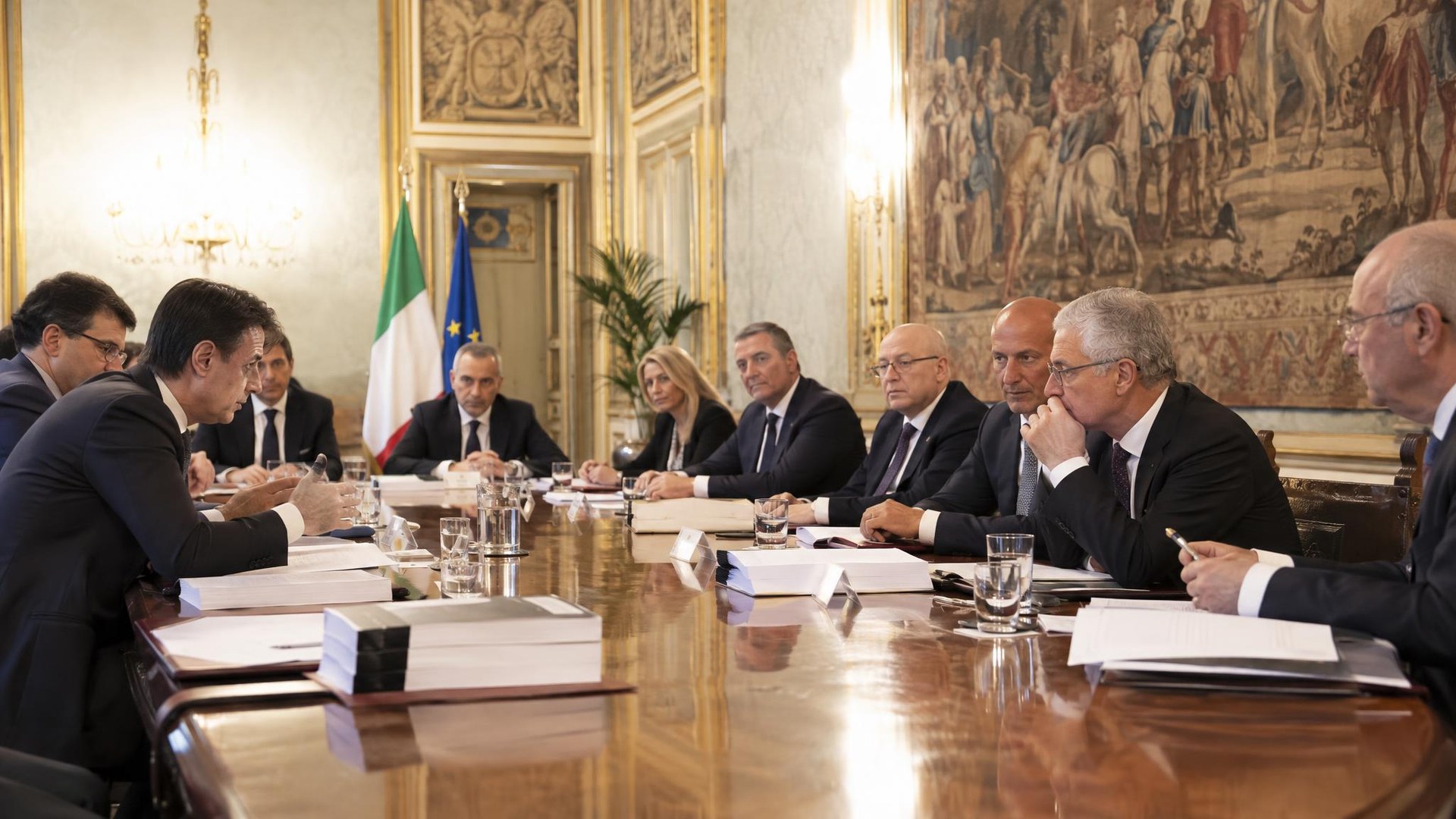
Italy’s Council of Ministers met at Palazzo Chigi on 28 oktober 2026, to examine the draft State budget for the 2027 financial year and the multi-year budget for 2027–2029, a manoeuvre that the government’s Draft Budgetary Plan funds in part through measures on gambling.
The convocation notice from the Presidency of the Council of Ministers called the meeting, the Council’s 195th, for 3:00 p.m. at Palazzo Chigi. Second on the agenda was the draft bill formally titled “Bilancio di previsione dello Stato per l’anno finanziario 2027 e bilancio pluriennale per il triennio 2027-2029,” under the Ministry of Economy and Finance. Ministers were also set to examine an urgent decree-law to reduce electricity and gas costs for families and businesses.
The government’s meeting notice added that a press conference with Prime Minister Giorgia Meloni, deputy prime ministers Antonio Tajani and Matteo Salvini, Economy Minister Giancarlo Giorgetti and Deputy Minister Maurizio Leo was under way.
Gambling Measures in the Funding Plan
The Draft Budgetary Plan for 2027, the planning document Italy submits to the European Commission and its own Parliament, lists “Misure in materia di giochi” (measures on gambling) among the resources of the 2027–2029 manoeuvre. The plan’s impact table records the gambling line as revenue of 0.03% of GDP in 2027, 0.03% in 2028 and 0.02% in 2029. Measures borne by the financial sector and measures on gambling contribute to financing the manoeuvre, the document states.
The same table sets out the remaining funding entries. Measures on the financial sector are entered at 0.21% of GDP in 2027, 0.13% in 2028 and 0.10% in 2029; a review of ministry spending at 0.05%, 0.08% and 0.08%; other revenue and coverage items at 0.05%, 0.14% and 0.23%, plus a one-off 0.02% in 2027; and further coverage items at 0.07% in each of the three years.
On the uses side, the table lists tax measures at -0.09% of GDP in 2027, -0.21% in 2028 and -0.16% in 2029; family policy and social spending at -0.21%, -0.12% and -0.11%; health at -0.10%, -0.08% and -0.07%; business support at -0.14%, -0.18% and -0.13%; infrastructure at -0.13%, -0.15% and -0.04%; defence at -0.19%, -0.20% and -0.03%; local authorities at -0.01%, -0.01% and -0.02%; and a one-off fund for court judgments at -0.08% in 2027. The document puts the manoeuvre’s overall impact at -0.54% of GDP in 2027, -0.56% in 2028 and -0.15% in 2029.
Spending Targets and the Safeguard Clause
In the plan, the government commits to annual net spending growth of 3.3% in 2027, 1.7% in 2028 and 0.2% in 2029. Excluding spending financed through the national safeguard clause, the targets are 1.9%, 1.7% and 1.5%.
The clause provides budget flexibility to strengthen defence capabilities and energy security. According to the plan, the government intends to use that flexibility in 2027 and 2028 for up to 0.3 percentage points of GDP per year for defence, plus up to 0.3 points for energy-security measures, a combined use that can reach 0.6 points in each of the two years while remaining within the 1.5%-of-GDP annual limit allowed by the European Commission. The Commission recommended on 8 oktober 2026, that the Council of the European Union authorize Italy to make use of the clause.
Under the policy scenario, the document projects a deficit of 3.4% of GDP in 2027, 3.2% in 2028 and 2.3% in 2029, with the debt ratio at 138.5% in 2027, 137.9% in 2028 and 136.6% in 2029.
Route to Parliament
The Council of Ministers approved the Draft Budgetary Plan on 13 oktober 2026, and Giorgetti presented it. The Economy Ministry announced on 15 oktober 2026 that the document had been sent to the European Commission and the Italian Parliament. The Parliamentary Budget Office validated the macroeconomic forecasts for the current-legislation and policy scenarios on September 29 and 12 oktober 2026, respectively.
The plan describes its interventions as feeding into a budget bill shortly to be presented to Parliament, and states that the precise definition of those interventions will take account of ongoing discussions with the European authorities on the perimeter of the safeguard clause.