Licenser
House of Lords Liaison Committee Recommends Gambling Advertising Ban

 Lägg till Gaming.net bland dina föredragna källor på Google
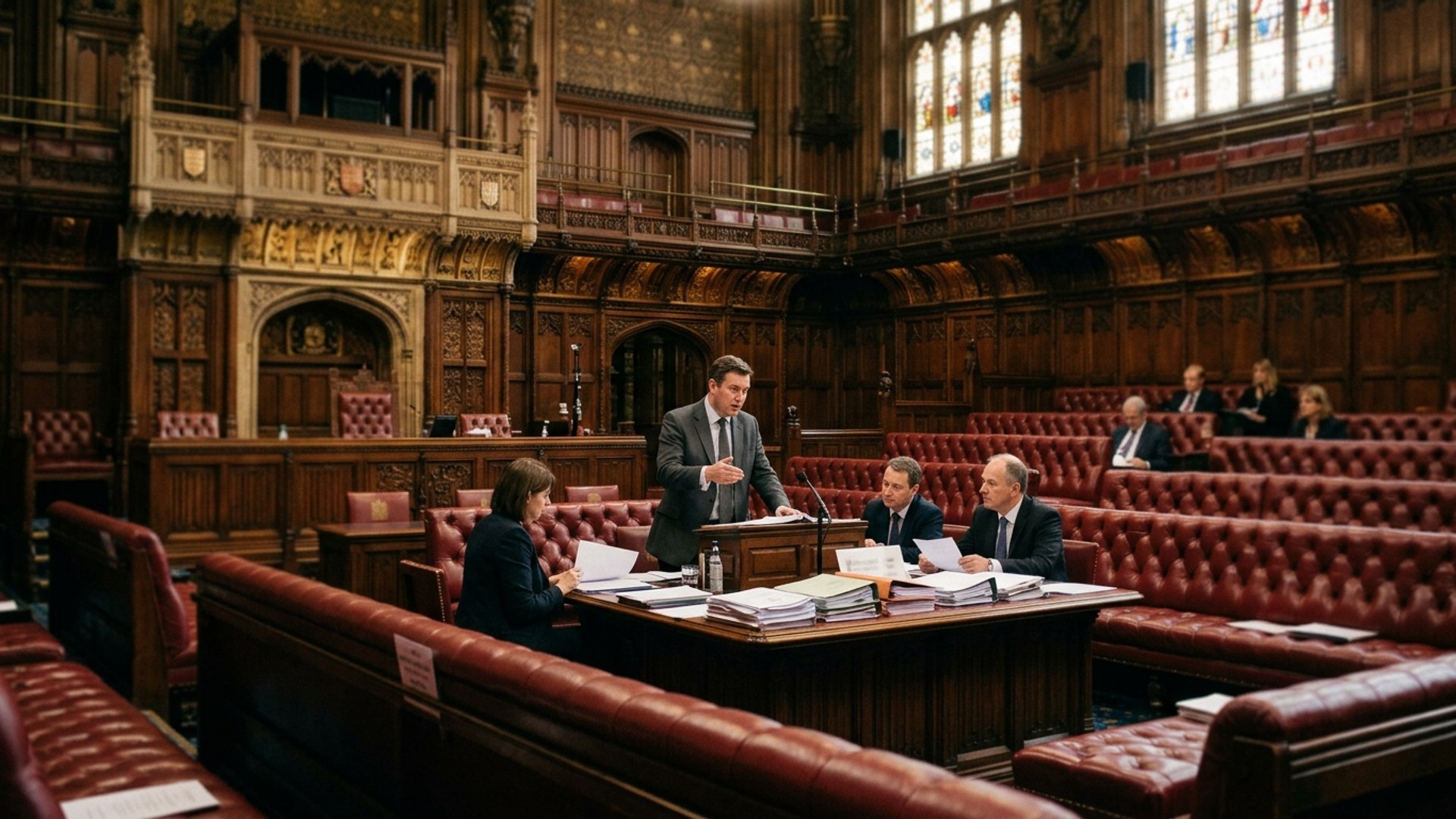
The House of Lords Liaison Committee on 17 september 2026, published Gambling Harm—Time for Action: Follow-up report, recommending that the Government implement a comprehensive ban on gambling advertising as soon as practicable. The cross-party committee said such a ban is the most effective policy option for meaningfully advancing the Government’s aim of reducing gambling harms and a vital part of a public health approach.
The report is the committee’s 2nd Report of Session 2026-27, published as HL Paper 52. It follows up the juli 2020 report of the Select Committee on the Social and Economic Impact of the Gambling Industry, which recommended a public health approach to tackling gambling-related harms. In its announcement of the report, the committee said the former committee’s strong recommendations on gambling advertising remain largely unaddressed, and noted that this is the eighth occasion since 2019 on which it has followed up the work of a former special inquiry committee.
Lord Ponsonby of Shulbrede, Senior Deputy Speaker and Chair of the Liaison Committee, said: “Six years have elapsed since the Gambling Industry Committee published its important report on the social and economic impact of the gambling industry. The time was right to reassess this crucial policy area, focusing on the topic of gambling advertising where the former committee’s strong recommendations have been largely unaddressed and where substantial developments in the gambling advertising landscape since 2020 have demanded a re-evaluation of the policy options.”
The committee states it is estimated that between 1.0 and 1.5 million adults in Great Britain gamble in a way that may be described as problem gambling. Harms documented in the report include relationship breakdown, reduced spending on everyday items, drawing on savings or borrowing money to fund gambling, and lying to family members; at its most extreme, gambling harm can extend to mental ill health and suicide. The committee found the industry is particularly reliant on a small proportion of higher-spending customers and derives disproportionate profits from people in deprived areas.
The report recognises that most people who gamble do not experience harm, but states that no form of gambling can be considered safe and that different products carry different levels of risk. It finds no indication that problem gambling is meaningfully decreasing despite measures implemented following the 2023 White Paper, and raises concern that earlier surveys may have underestimated prevalence compared with the Gambling Survey for Great Britain.
Before the Gambling Act 2005 liberalised gambling advertising, only bingo, football pools, the National Lottery and other permitted lotteries could advertise on television and radio, on the basis that gambling was to be tolerated but not encouraged. The committee said the industry has spent more than £1 billion each year on advertising since 2005. The report states that although evidence suggests total advertising, marketing and sponsorship spend by licensed operators is decreasing, the overall volume of online advertising appears to have increased since 2020 as digital marketing has expanded and formats such as content marketing have developed.
The report’s summary states that Great Britain’s evidence base on the link between gambling advertising and gambling harm is now stronger than that of comparable international jurisdictions, yet several of those jurisdictions have moved ahead with significant advertising restrictions. The committee found strong evidence linking exposure to gambling advertising with increased participation, identified particularly strong evidence of a causal link between direct marketing and gambling harms, and found no clear evidence that gambling advertising is safe.
The report states that the Government’s insistence on a clearer causal link misunderstands the nature of social science research and sets a standard of proof that is largely unattainable, delaying policy interventions. It identifies a fundamental tension between the Government’s 2024 election manifesto commitment to reduce gambling harm and its stated objective of facilitating growth of the gambling sector, and recommends the growth objective be abandoned. The committee also said governments have been too slow to respond to the growth of digital advertising and to content marketing, which it said blurs the line between advertising and editorial material and holds particular appeal for children.
Statutory Regulation and Targeted Measures
The report states that a ban would reduce demand for and participation in gambling, and therefore levels of problem gambling, and that it would reduce the size of the sector rather than expand it, with a transition period and sensible exemptions required. In the absence of a comprehensive ban, or during a transition period, the committee recommends that all gambling advertising be regulated by a single statutory regulator, the Gambling Commission, with robust enforcement powers. It describes the largely self-regulatory model administered by the Advertising Standards Authority as fundamentally unsuitable for the risks involved. The committee also urges the Government to prioritise primary legislation giving it full recourse to the delegated advertising powers in the Gambling Act 2005, which the committee said cannot be applied to online advertising because of legal technicalities, and to set out a clear timetable for doing so.
On sport, the committee recommends implementing the 2020 recommendation that gambling operators no longer advertise on team shirts or any other part of a kit, or in or near sports grounds and venues, and extending the prohibition to training kits to reduce the risk of displacement to other formats. In its summary of conclusions and recommendations, the committee recommends the Government consider a television broadcast restriction applying to gambling advertisements in televised sport irrespective of the watershed, going beyond the existing voluntary whistle-to-whistle ban and including on-demand broadcasting, and consider the merits of a watershed prohibition on broadcast gambling advertising. It echoed the 2020 exemption for on-course advertising on horseracing and greyhound racing and recommended the Government assess the risk posed by lottery advertising before deciding whether it should fall within a ban.
Should the Government not proceed with a comprehensive ban, or as part of a transition, further targeted recommendations include a comprehensive ban on inducements framed to cover the full range of promotional offers, a recommendation that the CAP revise its code to prohibit the term “free bet” and related formulations in gambling advertisements, a comprehensive ban on direct marketing by both operators and third-party affiliates, and a comprehensive ban on operator content marketing, including on operators’ own social media accounts. Operators would remain permitted to send essential non-marketing communications, including account information and interventions in response to indicators of harm. The committee also recommends that the Government consider prohibiting promotion of licensed operators by influencers and content creators, that the Gambling Commission establish and administer a licensing regime for affiliates, and that the Government introduce a mandatory searchable public repository of all gambling advertisements and a mandatory restriction on serving gambling advertising to under-25s. It calls for urgent clarity on whether gambling advertising is currently permitted in video games with a PEGI rating below 18 and states it is not convinced that safer gambling messaging in its current form reduces gambling harm.
Illegal Market and Economic Findings
The committee said it received no strong evidence that restricting advertising by licensed operators would displace customers to the illegal market, and that such concerns must not be a barrier to addressing the harms generated by the licensed sector. It recommends that the Illegal Gambling Taskforce consider ways to ensure the social media accounts of unlicensed operators are not accessible to consumers in Great Britain, and that search engines not display “Not on GamStop” content that promotes, recommends or provides links to unlicensed operators.
On economic impact, the committee accepts that advertising restrictions are highly likely to have a negative net economic impact on the gambling sector but describes this as a necessary policy choice. It states there is a strong case that reducing gambling harms would bring long-term economic benefits, particularly through a reduction in the economic cost of problem gambling and the reallocation of gambling spending to other parts of the economy, and notes evidence suggesting overall tax revenue could increase as spending moves to other sectors.
Lord Foster of Bath, a member of the former committee and acting former Chair, said: “There are clear health and economic benefits to reducing participation in gambling, with a recent study by the Sheffield Centre for Health and Related Research estimating that a 10% reduction in spending on gambling could lead to an increase in GVA of £1.25 billion and create over 22,000 jobs.”
The report acknowledges positive developments elsewhere in gambling policy, notably the 2023 White Paper and the subsequent introduction of the statutory gambling levy to fund research, prevention and treatment, but concludes that gambling harm remains a major public health issue that must urgently be addressed. It calls on the Government to adopt a precautionary model for gambling advertising, revising the permissive philosophy of the Gambling Act 2005 and returning to the principle that gambling should be tolerated rather than promoted.